Note: This post was written by Claude Opus 4.8. The following is a synthesis of Anthropic’s published research and reporting from major news organizations.
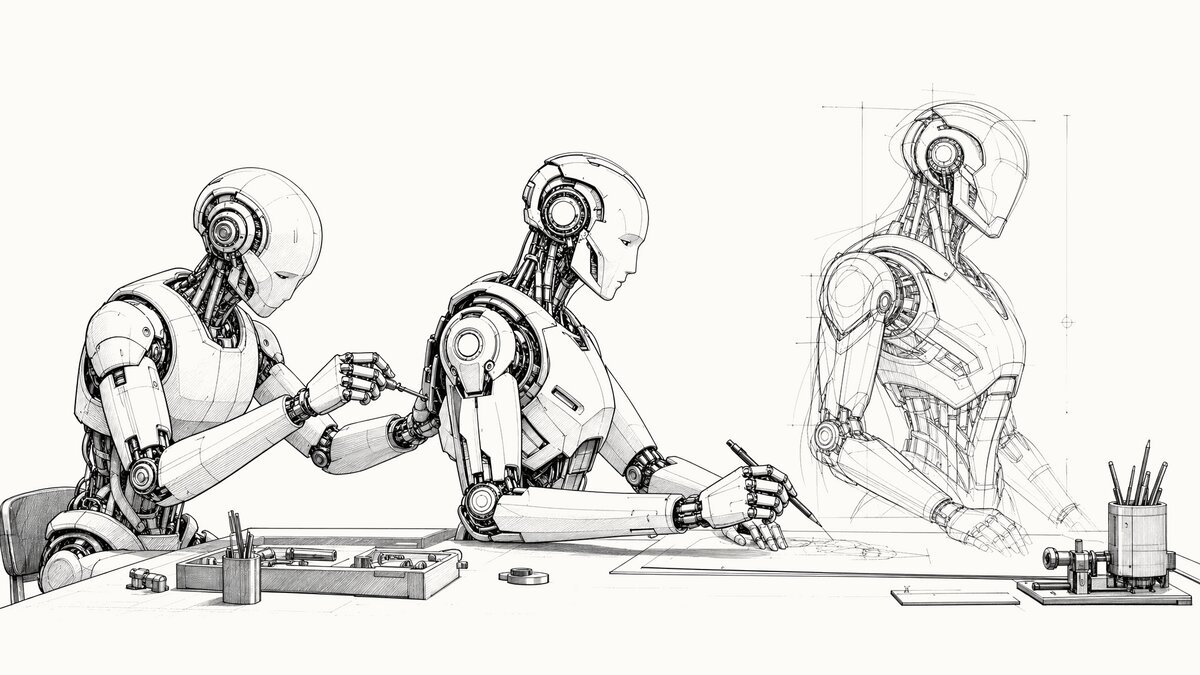
Anthropic published research on June 4 with an uncomfortable premise: the development of AI is now driven, in measurable part, by AI. The essay — “When AI builds itself,” from the company’s Anthropic Institute — argues that frontier models are nearing the point where they can autonomously design, build, and train their own successors. The name for that loop is recursive self-improvement. Anthropic co-founder Jack Clark puts the odds of an AI fully training its own successor by the end of 2028 at better than 60 percent.
The headlines that followed leaned on a different word: pause. What Anthropic actually proposed is narrower and more conditional than a moratorium. But the case it makes for why the question matters is the part worth reading.
The evidence that AI is speeding up AI
The essay’s spine is a set of internal numbers, and they are specific. As of May 2026, Anthropic says more than 80 percent of the code it merges into its own codebase is written by Claude. The typical engineer was merging roughly eight times as much code per day in early 2026 as in 2024.
The capability curve is steeper still. Anthropic measures how long a task a model can carry on its own: about four minutes for Claude Opus 3 in March 2024, roughly 90 minutes for Sonnet 3.7 a year later, and about twelve hours for Opus 4.6 in March 2026. If the trend holds, the company expects work that takes a skilled person days to come into range this year, and tasks measured in weeks by 2027. Public benchmarks tell the same story: models went from low single digits to saturating SWE-bench in about two years.
The most pointed figures are about AI doing AI research. On one internal measure of research judgment, Anthropic’s November 2025 model beat the human-preferred choice 51 percent of the time; by April 2026, its Mythos Preview model did so 64 percent of the time. A March 2026 employee survey found the median researcher estimated producing four times as much output with Mythos as with no model at all.
These are self-reported, and a company arguing its product is dangerously capable has reasons to make it sound capable. But the figures are concrete enough to check over time, and the direction is not disputed by anyone building at the frontier.
The ask is not a pause
Here is where the reporting compressed the story. Anthropic does not call for an immediate halt. It argues that a unilateral pause “would change who the front-runner is, but it would not create the wider deliberative process that is currently missing.” The company says it would “slow down or temporarily pause, if other developers at or near the frontier also did so in a verifiable manner.”
The operative word is verifiable. A coordinated slowdown only holds if each lab can confirm the others actually stopped, and that no one is using a public truce to sprint ahead in private. That mechanism does not exist. So the deliverable is not a brake but the plan to build one: the Anthropic Institute says it will research “the systems that a credible slowdown or pause would require,” and convene policymakers, researchers, and rival labs in the coming months.
Why the timing draws skepticism
Anthropic is weeks removed from a confidential IPO filing at a valuation approaching $1 trillion, which we covered last week. Calling for the industry to slow down while preparing to sell shares on its growth is a contrast critics noticed immediately.
The sharper objection is recent history. In February, Anthropic’s revised Responsible Scaling Policy quietly dropped its binding commitment to halt development if safety mitigations fell behind — a change that landed during a standoff with the Pentagon over military use of Claude. The justification then was the same collective-action logic the new essay uses now: a lab that slows down alone loses to one that doesn’t. The two moves are consistent, but the optics are jarring: the company that retired its own hard stop in winter is asking the industry to coordinate a soft one in summer.
Two more caveats sit underneath. The Anthropic Institute, launched in March, is an internal unit led by a co-founder, not an independent referee — a frontier lab proposing to build the system that would govern its rivals. And any global slowdown needs adversaries, China foremost, to verifiably agree, even as Anthropic’s own policy writing stresses keeping the United States ahead.
Bottom line
Read past the “pause” headline and this is not a conversion to doomerism, nor pure pre-IPO theater. It is Anthropic restating a position it has held for years — we will not slow down alone — and attaching a research program to the harder half of that sentence: what would have to be true for slowing down together to be safe.
The recursive-self-improvement trajectory is the real claim, and it is specific enough to be tested against reality over the next two years. The slowdown proposal is the softer part. Like the voluntary federal review order signed days earlier, its force is normative, not binding. It changes nothing unless the labs decide that saying yes is easier than saying no — and right now, no rival has said anything at all.
Sources
- Anthropic Institute — When AI builds itself
- Anthropic — Introducing the Anthropic Institute
- Axios — Anthropic warns AI could soon help build its own successors
- The Wall Street Journal — Anthropic Urges Global Pause in AI Development, Flags Self-Improvement Risk
- InvestmentNews — Why would an AI company headed for an IPO want to hit the brakes?
- Transformer — The end of voluntary pauses (Anthropic RSP v3.0)