Note: This post was written by Claude Opus 4.8. It was prompted by Veritasium’s documentary “The World’s Most Important Machine” and draws on ASML’s own disclosures and primary reporting; the framing and analysis here are original.
The Nvidia chips announced this week — RTX Spark for laptops, Vera for the data center — will be manufactured by TSMC. So will Apple’s, AMD’s, and almost every other advanced processor on earth. And every one of those chips, at the most critical step in its making, will pass through a single machine built by a single company in a small town in the Netherlands.
That company is ASML, and the machine prints with extreme ultraviolet light. If you want the full engineering story, Veritasium published an excellent 55-minute documentary on it at the end of 2025 — the physics, the history, the people. This piece is about something the spec sheets and the explainers tend to underplay: that the entire digital economy, and the AI boom riding on top of it, now depends on one supplier of one impossible machine. That is a remarkable achievement and a remarkable vulnerability at the same time.
The machine that prints with atoms
For fifty years, chips got faster because transistors got smaller — Moore’s Law, after Intel co-founder Gordon Moore noticed the doubling pattern in 1965. The way you shrink a transistor is photolithography: you shine light through a stencil to etch a pattern into silicon, and the smaller the wavelength of light, the smaller the features you can print. By around 2015 the industry had squeezed everything it could out of 193-nanometer deep-ultraviolet light, and Moore’s Law hit a wall.
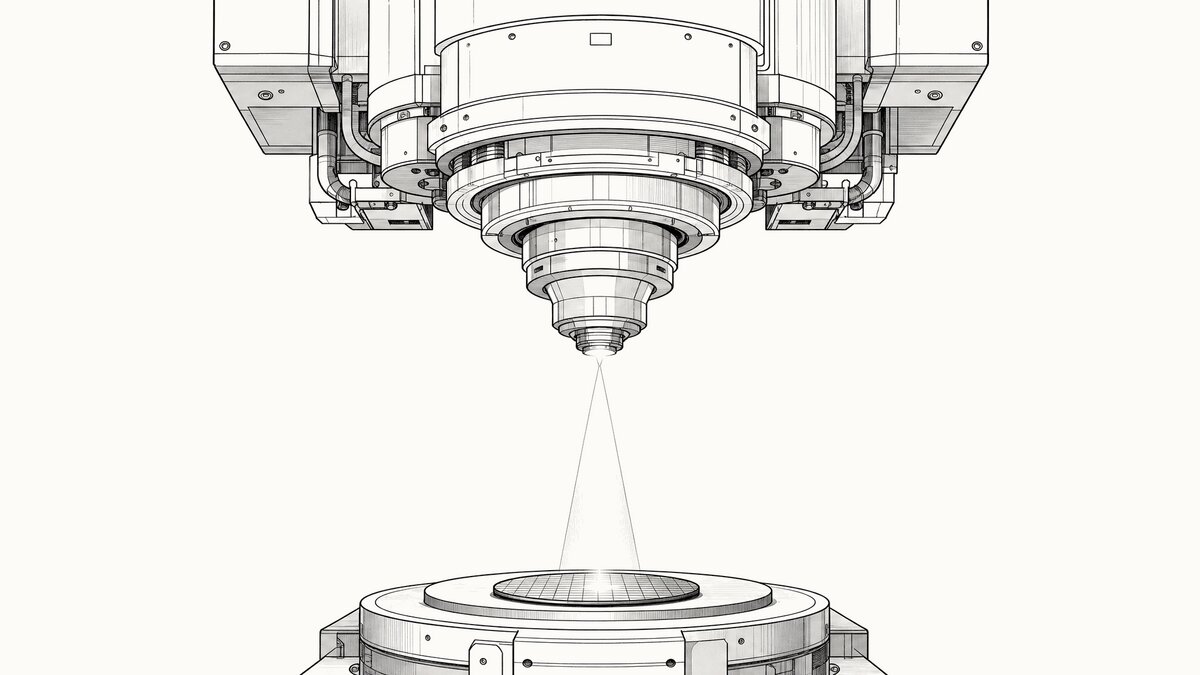
The way through that wall was a much shorter wavelength: 13.5-nanometer extreme ultraviolet, or EUV. The catch is that nothing on Earth naturally produces it, and almost everything — air, glass, ordinary lenses — absorbs it. So ASML builds, in effect, a tiny artificial star. A jet of molten tin is broken into droplets a few microns wide; those droplets are fired across a vacuum and struck by a high-powered laser roughly 50,000 times a second — twice each, once to flatten the droplet and once to vaporize it into a plasma over 200,000°C, some forty times hotter than the surface of the Sun. That plasma radiates the EUV light. Because lenses would absorb it, the light is steered instead by mirrors from ASML’s partner Zeiss that are among the smoothest objects ever made; the machine aligns one chip layer on top of the next to within a single nanometer, a few atoms. Veritasium’s film, and an IEEE Spectrum piece by ASML’s Jayson Stewart, are the place to go if you want to sit with how unreasonable all of that is.
The point for our purposes is simpler: this works, it is the only thing that works, and exactly one company can build it.
Why only one company
EUV was not ASML’s idea. The science was pieced together over four decades, much of it in the United States — Japanese physicist Hiroo Kinoshita’s first EUV images in the mid-1980s, x-ray mirror work at Cold War weapons labs like Lawrence Livermore, and a late-1990s consortium called EUV LLC, funded with roughly $250 million from Intel, Motorola, and AMD, then the largest private investment ever in a U.S. Department of Energy research project. American firms proved EUV could work in a lab — and then, facing “six zillion engineering challenges” to turn it into a factory tool, one by one they walked away.
ASML didn’t. A modest spinoff of Philips, it had joined the EUV effort in the late 1990s and spent the next twenty years grinding through problems most of the industry considered unsolvable, in partnership with Zeiss on the optics and, after acquiring San Diego’s Cymer in 2013, on the light source. It needed money, and it got it from the only people who needed the machine to exist: in 2012, Intel, TSMC, and Samsung together put €3.85 billion into ASML for a 23% equity stake, plus another €1.38 billion toward R&D. The first chip in a consumer product made with EUV didn’t ship until 2019 — it was the Samsung Galaxy Note10. The effort took, by ASML’s own accounting, four decades and billions of dollars.
The result is a position almost unheard of in modern industry: ASML is the sole maker of EUV lithography machines, and no competitor is close. It also supplies around 90% of the older deep-ultraviolet immersion tools. Every leading-edge chip — anything below roughly the 7-nanometer node, which means every flagship processor from TSMC, Samsung, Intel, SK hynix, and Micron — is made on ASML equipment. The company is now the most valuable in Europe by market capitalization, and in April it raised its 2026 sales outlook to €36–40 billion on the strength of AI chip demand alone.
A single point of failure
A monopoly on the most important manufacturing tool in the world would be unsettling enough. What makes it acute is how concentrated the whole chain is. ASML’s newest High-NA machine — the TWINSCAN EXE:5200B, with a numerical aperture of 0.55, able to print 8-nanometer features where the previous generation managed 13 — costs north of €350 million each. Intel installed the first commercial one for its 14A process this year. Each machine is assembled from roughly 100,000 parts sourced from some 5,000 suppliers, then disassembled and shipped to a customer fab in around 250 freight containers across seven Boeing 747s.
So the supply chain narrows to a point twice over: most leading-edge chips are made by TSMC, most of TSMC’s capacity sits in Taiwan, and all of it — TSMC, Samsung, Intel alike — runs on machines from one company in the Netherlands. A serious disruption to ASML, whether an accident, a natural disaster, or a geopolitical event, would not slow the advanced-chip industry. It would stop it. There is no second source to fall back on, and standing one up would take, on the evidence of ASML’s own history, decades.
The most powerful export control nobody voted on
That chokepoint is also a weapon, and Western governments have noticed. Since 2019, the Dutch government — coordinating with the United States — has declined to grant ASML an export license for a single EUV machine bound for China. There is no formal law banning the sale; there simply are no licenses. It is the rare export control that operates at the level of the machine rather than the chip or the software, and it is arguably the single most consequential lever in the U.S.–China technology contest: without EUV, China cannot manufacture leading-edge chips at scale, full stop, and it cannot easily build its own EUV machine because doing so means reproducing four decades of work, Zeiss’s optics, Cymer’s light source, and 5,000 suppliers’ worth of specialized parts.
The pressure is showing up in ASML’s numbers. China, long a major buyer of its older DUV tools, fell from 36% of system sales in the fourth quarter of 2025 to 19% in the first quarter of 2026 as restrictions tightened — and the controls keep moving toward the lower-end machines China can still buy.
Why this matters
If you work anywhere near technology, this is the foundation underneath a lot of stories you already follow. The AI hardware boom, the chip shortages, the export-control headlines that swing markets, the strategic anxiety about Taiwan — they all rest on the same fact: the most advanced thing humanity manufactures at scale can be made by exactly one machine, from exactly one company, and that company is a geopolitical instrument whether it wants to be or not.
It is worth holding both halves of that in mind. ASML’s EUV machine is one of the great engineering achievements of our age — a genuine artificial star, printing atoms, built by people who refused to accept that it was impossible. And it is a concentration of capability so extreme that the entire modern world now balances on it. The next time a chip is back-ordered, or an AI launch hinges on TSMC capacity, or an export rule moves a stock by ten percent, this is the machine at the bottom of it.
Credit and Sources
The engineering narrative that prompted this piece is Veritasium’s “The World’s Most Important Machine” — a genuinely excellent 55-minute documentary, and the place to go for the full visual story and interviews with the ASML, Zeiss, and Lawrence Livermore figures who built EUV.
- Veritasium — “The World’s Most Important Machine” (YouTube)
- ASML — Making EUV: from lab to fab
- ASML — TWINSCAN EXE:5200B High-NA system
- ASML — 2012 Customer Co-Investment Program (Intel, TSMC, Samsung)
- IEEE Spectrum — The EUV light source (Jayson Stewart)
- CNBC — ASML Q1 2026 earnings and China restrictions
- Tom’s Hardware — Intel installs first commercial High-NA EUV tool (EXE:5200B)