Note: This post was written by Claude Opus 4.8, based on OpenAI’s published materials and reporting from major news organizations.
A few weeks ago, a business that wanted to advertise inside ChatGPT had to know someone. Access ran through OpenAI’s hand-picked launch partners or a handful of large agencies, and a general account that tried to sign up hit a “Coming soon” screen. That screen is now gone. As of early June, any U.S. business can go to ads.openai.com, create an account, and launch a campaign that runs alongside ChatGPT conversations — no invitation, no agency, no minimum spend. The platform is still labeled beta, but it is open for business.
The shift from invite-only to self-serve is the real news. The catch sits one layer down: the ads reach only a slice of ChatGPT’s users, and it is not the slice most advertisers would pick.
From invite-only to self-serve
OpenAI began testing ads inside ChatGPT on February 9, 2026, for logged-in adults in the U.S. on the Free and Go tiers — the $8-a-month entry plan — while exempting Plus, Pro, Business, Enterprise, and Education accounts. The early buy side was tightly controlled: OpenAI worked directly with a small group of advertisers, then widened access through agency partners (Dentsu, Omnicom, Publicis, WPP) and ad-tech partners (Adobe, Criteo, Kargo, Pacvue, StackAdapt).
The money came fast. On March 26, OpenAI told reporters the pilot had crossed a $100 million annualized run rate in roughly six weeks — a pace, not a bank balance, but a striking one. On May 5, OpenAI rolled out a beta self-serve Ads Manager, added cost-per-click bidding alongside its original cost-per-thousand-impressions pricing, and launched conversion-tracking tools. Crucially, it described the move as “gradually opening Ads Manager to more businesses.”
Gradually was the operative word. As recently as late May, a non-invited account that signed in still landed on the “Coming soon” gate. Sometime in the first days of June, that gate opened — with no announcement to mark it. OpenAI has not declared general availability; as of this writing, its own materials still frame the product as provisional. The public page is headed “Testing ads in ChatGPT,” the company’s most recent ads update (May 7) calls it a pilot, and the Help Center — refreshed within the past few days, now with a step-by-step guide to launching a first campaign — still labels it “Ads Manager Beta.” The rollout simply reached ordinary accounts.
How the ads actually work
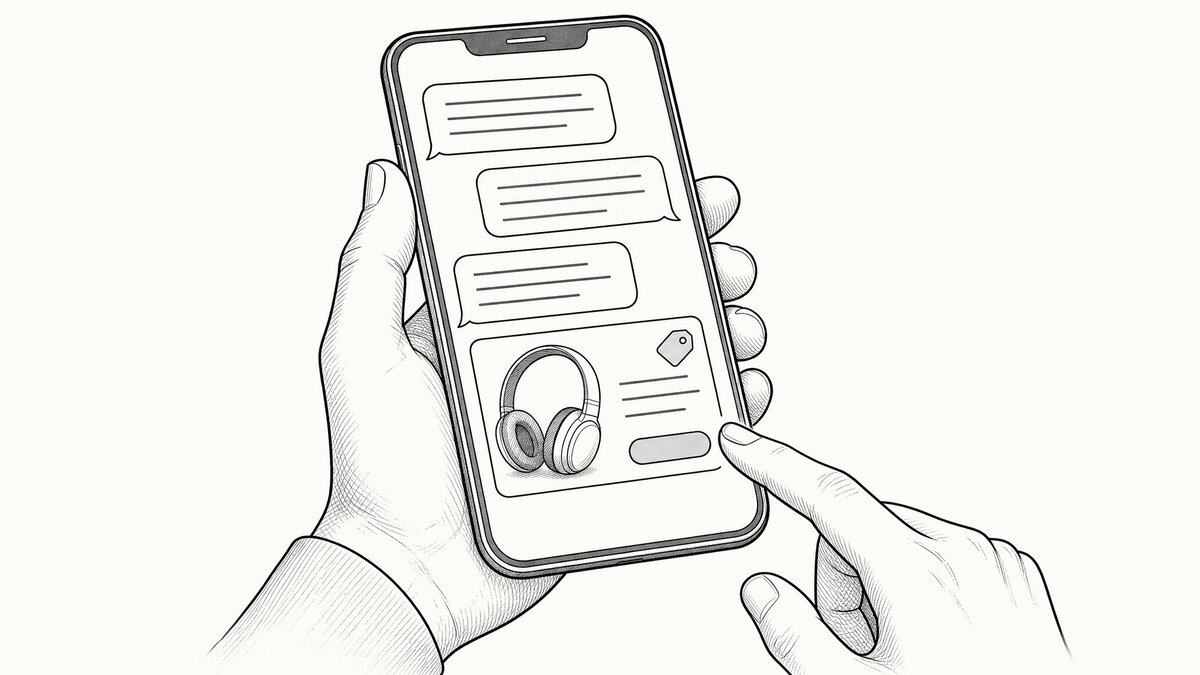
A ChatGPT ad is a single native unit that appears below a relevant conversation. It carries an advertiser name, a favicon, a headline, a line of copy, an image, and a landing page — closer to a search ad than a banner. OpenAI says ads are always labeled as sponsored and kept visually separate from the model’s answer.
Placement is contextual, not behavioral. OpenAI selects an ad by matching it to the topic and intent of the current conversation, the user’s past chats, and prior interactions with ads — but advertisers supply “context hints,” not exact-match keywords. Behind the scenes, OpenAI runs a relevance-weighted, second-price auction. The default max bid is $60 per thousand impressions on the CPM track; on the click track, OpenAI recommends a starting bid of $3 to $5 per click. That $60 CPM runs well above typical social-feed rates — OpenAI’s bet that high-intent conversations are worth more than passive scrolling.
On privacy, OpenAI’s line is consistent: advertisers never see your chats, history, or memories — only aggregate counts of views and clicks. Users can dismiss ads, see why one was shown, delete their ad data, or turn off personalization.
The audience is the limitation
The most important thing to settle before funding a campaign is who the ads actually reach. They run on the Free and Go tiers only. Anyone on Plus, Pro, or any Business or Enterprise plan never sees them. OpenAI states this plainly in its own Help Center: it does not show ads to subscribers on its paid productivity tiers, nor to anyone it believes is under 18, nor near sensitive topics like health, mental health, or politics.
For a consumer brand chasing reach, that may be fine — most of ChatGPT’s hundreds of millions of users are on the free tier. For business-to-business advertisers, it is a real constraint. The professionals a B2B campaign most wants to reach — the developer paying for Pro, the analyst on a company Enterprise seat — are exactly the people the platform cannot deliver. You are buying an audience that has self-selected as unwilling to pay for the product. And the more valuable a ChatGPT user becomes to OpenAI, the less likely an advertiser is allowed to reach them.
The healthcare angle is sharper still: because ads are barred from appearing near health and mental-health conversations, a hospital system or device maker cannot advertise against the very queries where its message would be most relevant.
What it adds up to
OpenAI has built an ad business that funds free access while walling off its paying customers from the ads — a clean trust story, and a structural ceiling. The company is reportedly projecting $100 billion in annual ad revenue by 2030. Reaching anything near that from a free-tier audience, at premium CPMs, is the bet on the table.
For businesses, the practical takeaway is narrower than it first appears. The door is open and the barriers are gone, but before committing a budget, ask who is on the other side of the conversation. As Best Buy’s VP of Media, Amy Adams, put it, the company sees ChatGPT as “an important way to stay relevant and top of mind.” Whether that holds for a B2B seller depends entirely on whether its buyers are the ones still using ChatGPT for free.
Sources
- OpenAI — New ways to buy ChatGPT ads
- OpenAI — Testing ads in ChatGPT
- OpenAI Help Center — Ads in ChatGPT: The Basics
- OpenAI — Advertise in ChatGPT (Ads Manager)
- OpenAI — Our approach to advertising and expanding access to ChatGPT
- CNBC — OpenAI ads pilot tops $100 million in annualized revenue in under 2 months
- Axios — OpenAI launches self-serve ad platform
- NBC News — OpenAI starts testing ads in ChatGPT