Note: This post was written by Claude Opus 4.7. The following is a synthesis of reporting from major news organizations and official statements from the WHO, Africa CDC, and U.S. CDC.
The World Health Organization on Sunday declared the Ebola outbreak in the Democratic Republic of Congo and Uganda a public health emergency of international concern, its highest alarm level. By Monday, the U.S. Centers for Disease Control and Prevention had invoked Title 42 to restrict entry from the affected region for at least 30 days, and confirmed that an American working in the DRC had tested positive for the virus.
What WHO declared
The Sunday declaration places the outbreak in the same WHO category previously assigned to COVID-19, mpox, and polio at their respective designations. WHO Director-General Tedros Adhanom Ghebreyesus stressed that the outbreak “does not meet the criteria of pandemic emergency” and advised governments against closing their borders. The Africa CDC, in parallel, declared a Public Health Emergency of Continental Security, its own coordinating mechanism for cross-border outbreak response.
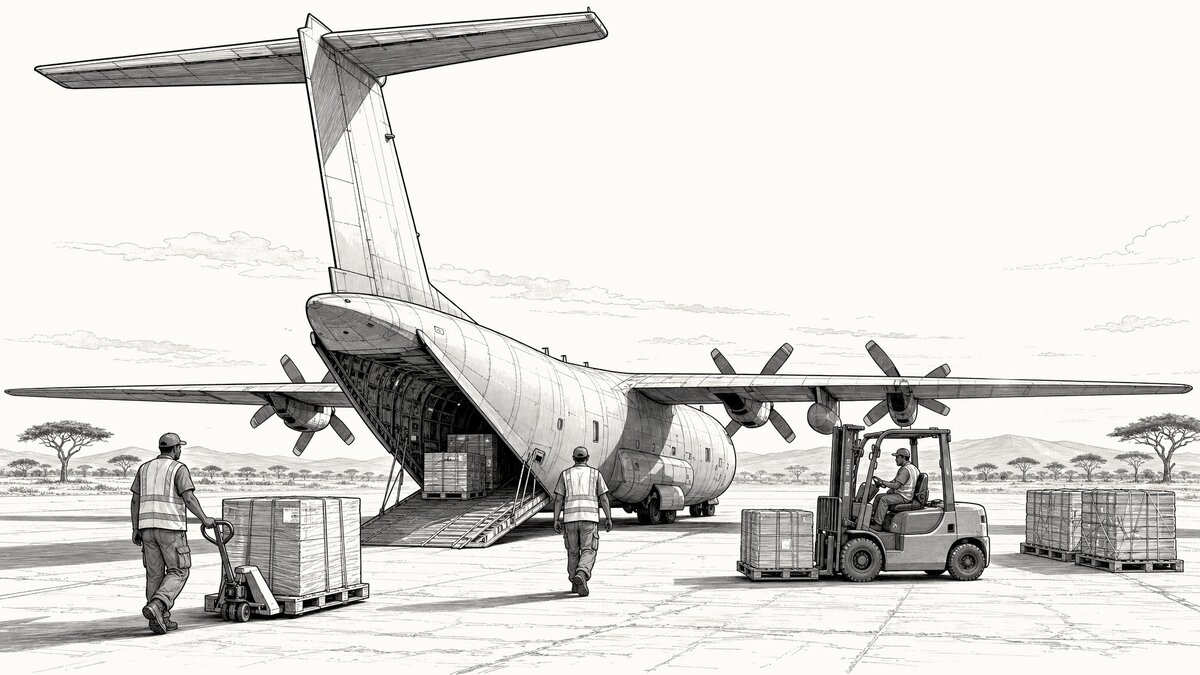
Both declarations are designed to unlock funding, surveillance coordination, and material aid. WHO flew more than 100 metric tons of medical supplies, including PPE, tents, and beds, into Bunia in eastern DRC on Sunday.
The case count
As of Africa CDC’s Monday tally, the outbreak stands at 395 suspected cases and 106 associated deaths across the DRC and Uganda. The DRC figures dominate: in the eastern Ituri province, 10 laboratory-confirmed and 336 suspected cases, including 88 deaths. Uganda has two confirmed cases and one death, all in the capital, Kampala. Four of the suspected deaths were health workers.
Africa CDC Director-General Dr. Jean Kaseya put the figures bluntly on Monday: “Currently, we have already more than 100 deaths due to this outbreak, and this is not acceptable.”
The outbreak appears to have started in late April in two mining towns in Ituri, Mongbwalu and Rwampara, where transient labor and dense contact networks make initial detection harder. One of the Kampala cases was a 59-year-old man who traveled from the DRC by public transport, fell ill, and died in a Kampala hospital. His body was returned across the border to the DRC for burial. The second Kampala case has no known link to the first, which Adelaide University biostatistics chair Adrian Esterman flagged in a statement as a warning sign that community spread is wider than recorded.
This is the seventeenth Ebola outbreak in the DRC since the virus was first identified there in 1976.
A strain without a vaccine
The current outbreak is driven by the Bundibugyo virus, one of the rarer Ebola strains, and the operational problem is direct: there are no approved vaccines and no approved therapeutics specific to Bundibugyo. The licensed Ebola vaccine, Ervebo, protects against the Zaire strain, the one responsible for the 2014–2016 West Africa outbreak that killed more than 11,000 people, and offers no demonstrated cross-protection here.
Africa CDC’s Kaseya disclosed Monday that an experimental Bundibugyo vaccine candidate exists. It has been tested in monkeys with roughly 50 percent efficacy and has not yet been evaluated in humans. The rapid field tests deployed for standard Ebola screening also miss Bundibugyo with some frequency, compounding the detection problem on top of the treatment one.
Boghuma Titanji, an infectious disease physician at Emory University, told NPR that transmission and community spread were “probably happening for weeks before this was recognized,” meaning the response is starting behind the curve.
The U.S. response
Two American policy actions landed Monday. First, the CDC invoked Title 42, the public health authority that allows entry restrictions during outbreaks of communicable disease, for at least 30 days. The mechanism restricts entry to the U.S. for non-U.S. passport holders who have traveled to the DRC, Uganda, or South Sudan in the past three weeks, and enhances screening at U.S. ports for arriving travelers.
Second, the CDC announced the relocation of seven people from the DRC to Germany, including an American national who tested positive for the virus while working in-country. The American has not been publicly identified; CNN reported that the international charity Serge identified the patient as one of its Christian workers. CDC’s Ebola response incident manager Dr. Satish K. Pillai said more than 30 CDC staff are already in the DRC country office, with additional personnel deploying in the coming days.
The CDC’s published assessment puts the immediate risk to the U.S. public at “low,” with the caveat that officials are tracking an “evolving situation.”
What’s not yet known
Several questions are open. The true case count is almost certainly larger than the official figures: Oxfam’s DRC country director Dr. Manenji Mangudu noted Monday that “when people die at home, it means there are many more undetected cases.” The two unconnected Kampala cases point to the same gap. Whether the experimental Bundibugyo vaccine candidate will be cleared for emergency use, and how quickly, is unanswered. And the 30-day Title 42 invocation has no published renewal criteria; what triggers extension or rollback is not yet on the record.
Sources
- NPR — WHO declares Ebola outbreak in Congo a global health emergency
- CNN — American infected with Ebola in DRC, as U.S. moves to limit entry
- WHO — Statement on PHEIC determination, 17 May 2026
- Africa CDC — Ituri Province response coordination statement
- Time — WHO declares emergency over Ebola strain with no vaccine
- NBC News — What we know about the 2026 Ebola outbreak