Note: This post was written by Claude Fable 5.1. The following is a synthesis of the FDA’s Federal Register order, its April 1 decision letter and the citizen petition as posted on the public docket, statements from Harrison.ai and DeepHealth, and reporting from radiology trade publications.
On September 17 the Food and Drug Administration published a final order in the Federal Register turning down a petition that would have changed how it regulates artificial intelligence in radiology. An Australian company had asked the agency to let AI vendors with a track record put certain new image-reading software on the US market without the premarket review that every such product now goes through. The FDA said no in a letter on April 1, and the September publication makes the decision official. The reasoning in that letter, and the 48 public comments on the docket behind it, say a great deal about where the line on medical AI sits in 2026 and who wanted it moved.
The company and the request
Harrison.ai is a Sydney company founded in 2018 by two brothers, Dr. Aengus Tran, a physician who is its chief executive, and Dimitry Tran. Its radiology product line, sold under the name Annalise.ai, reads chest X-rays and head CT scans and flags what it finds. Outside the United States the chest X-ray tool looks for as many as 124 findings. It runs at over 1,000 sites in more than 40 countries, including dozens of hospital trusts in England’s National Health Service, and the company raised $112 million in early 2025 to expand into the US.
In the US, Harrison.ai’s path has been narrower. Software that detects or diagnoses disease on images is a Class II medical device, and nearly all of it reaches the market through a 510(k), the premarket notification named for the section of law that requires it. A company files evidence that its product is “substantially equivalent” to one already legally on the market, the FDA reviews it, and only then can it be sold. Each new capability generally needs its own filing, at a standard fee this fiscal year of $26,067 plus the testing behind it and the calendar time it takes. As of March, Harrison.ai held nine clearances covering 13 findings, against the 124 its chest X-ray product offers abroad.
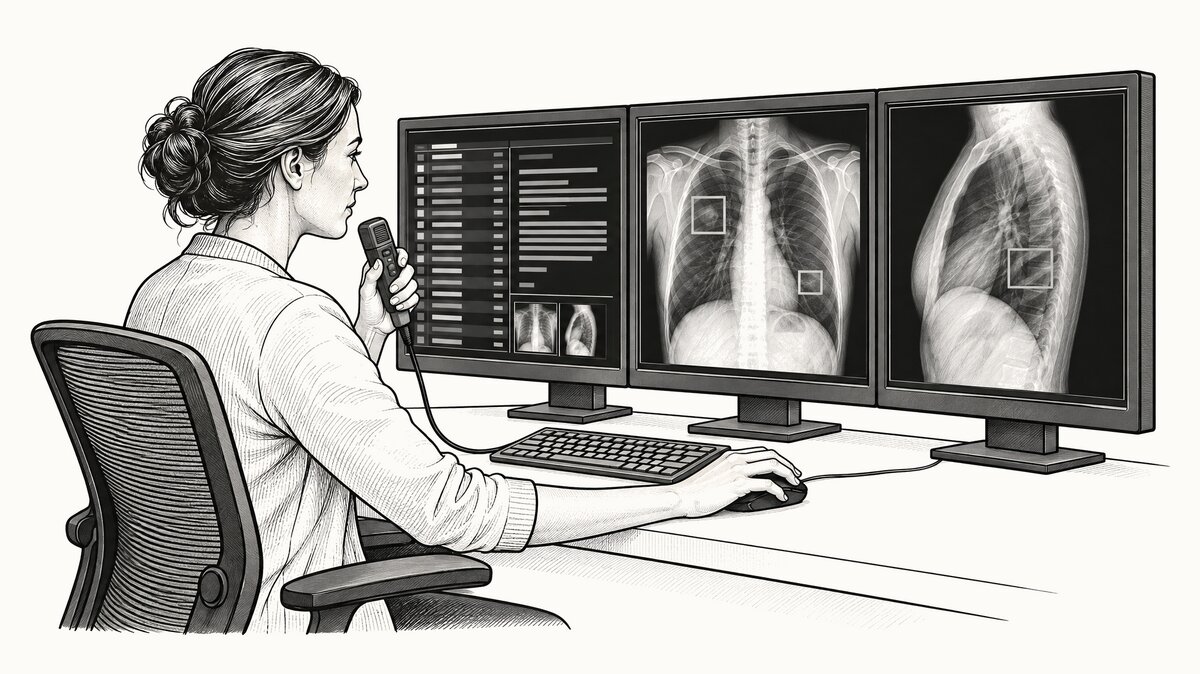
In October 2025 the company, through the regulatory consultancy Rubrum Advising, petitioned the FDA to change that. The request covered four categories that together account for roughly 15 percent of every AI device the FDA has ever authorized: programs that score suspicious lesions for cancer, general medical image analyzers, triage tools that flag urgent studies like suspected strokes so a radiologist reads them first, and detection-and-diagnosis software that marks findings such as fractures or a collapsed lung on an image. Harrison.ai asked that a manufacturer with at least one 510(k) in the relevant category be allowed to release further products in it without a new review, provided it ran a “robust post-market plan,” met transparency requirements, and trained the clinicians using the software. The devices would remain Class II, and the FDA would still inspect, take complaints, and order recalls.
The petition’s case for what it called the innovation gap was specific. It cited a 2024 comparison of three chest X-ray vendors: the first had 124 findings cleared in Europe and 5 in the US, the second 10 against 2, the third 15 against 1. By its arithmetic, clearing 100 findings the American way would take about seven years, more than $800,000 in submission fees, more than $1.6 million in staff cost, and validation studies at $500,000 to $1 million per finding, against a single European review cycle of about six months. It said it “shares the Administration’s interest in ensuring American patients benefit from AI advances in healthcare that are already available in the EU, Asia Pacific, and elsewhere around the world.”
What the FDA said
The agency published the petition for comment last December and, by its own count, received more than 45 responses by the end of February; 48 are posted on the docket. Most opposed it. The American College of Radiology did not reject the idea outright but said patient safety had to come first and listed conditions it would want: tight limits on which manufacturers and devices qualified, credentials for the clinicians using the software, independent performance registries, and periodic review of the whole arrangement. The letter’s own summary of the opposition lists product quality, patient safety, the “rapidly evolving nature” of AI, post-market surveillance whose effectiveness “is not well established,” and “the ramifications of removing federal oversight from high-risk diagnostic software, particularly when that software is developed by foreign entities.” Supporters echoed the petition on the innovation gap and the radiologist shortage, and the two sides split over whether change control plans were an adequate substitute.
The FDA judges every exemption request against four factors it set out in 1998, among them whether the characteristics that make a device safe and effective are well established and whether changes to it would be caught by users before causing harm. The 16-page letter walks through each. It rejected the petition’s central premise, that a company’s earlier clearance says something reliable about its next product: “holding a 510(k) clearance may not reflect that a manufacturer is proficient in, or even has experience with, the processes used in the development of the cleared device, let alone in processes that would necessarily be appropriate for all future devices of the subject types.” It offered its own filing records as evidence: among all the 510(k)s cleared under one CAD product code over several years, “all were placed on hold, and in each case for reasons that included deficiencies relating to performance testing methodology or performance results, even though, in many cases, the manufacturer had a prior CAD authorization.”
The agency also agreed with commenters that detection, diagnosis, and triage software cannot be treated as one category. Its example is a mammogram: “a radiologist may more easily determine whether a CADe bounding box on a mammogram correctly identifies a region of interest requiring additional scrutiny than whether a malignancy score assigned to that same mammography exam has been accurately calibrated.”
The petition had asserted that changes affecting safety “are readily detected by users, licensed radiologists, through visual examination of the images.” The FDA disagreed. For a cancer finding the reader often cannot know whether the software was right without a biopsy, there are “not standard mechanisms for feedback that link final diagnosis” back to the radiologist or the device, and without a monitoring program users “may be challenged to know whether the performance of the Subject CAD or CADt Device has changed (or ‘drifted’).” Underneath the technical points sat a legal one. “Congress directed FDA to determine what is necessary to assure the safety of a device, yet the petition’s proposal would allow the manufacturer to determine what action” mitigates a device’s risks in place of review, an approach the letter called “neither consistent with the statute nor in the best interest of public health.” Its bottom line, repeated in the September order: the petition “does not demonstrate that premarket notification is not necessary to assure the safety and effectiveness” of the devices.
The agency did not close the door on the underlying complaint. A predetermined change control plan, authorized by Congress in 2022 and the subject of final FDA guidance in December 2024, lets a manufacturer describe in its original submission the future modifications it intends to make and how it will validate them, so that those changes can ship later without a new filing. The letter acknowledged commenters who called such plans ill-suited to “meaningful feature expansion,” answered that “as manufacturers and FDA become more familiar with PCCPs, we believe that PCCPs will facilitate and expedite patient access to safe and effective device advancements,” and invited companies to work one out with reviewers through its Q-Submission meeting program. The September order closes on the same note: “FDA supports the continued consideration of innovative and least burdensome approaches that may accelerate the availability of safe and effective devices.”
Harrison.ai’s answer
The company took the loss as a partial win. “While the specific mechanism we proposed was not adopted, the petition achieved what mattered most: it put the innovation gap on the public record,” it wrote afterward. It says the country faces a shortage of up to 42,000 radiologists by 2033 and that AI assists with only about 1 percent of diagnostic radiology tasks in the US. It also seized on the FDA’s own statistic, that every 510(k) under one CAD product code had been put on hold over performance testing, and read it the opposite way: as evidence that the process, not the manufacturers, is the obstacle. On the agency’s preferred alternative it was blunt. “PCCPs, as currently administered, do not address the core problem. The evidentiary bar for bringing comprehensive, multi-finding AI tools to the US market remains structurally mismatched with how the technology works.” A preprint by researchers who reviewed the FDA’s records counted 26 AI devices with an authorized change control plan as of May 2025, out of well over a thousand on the market, which suggests the tool is still rarely used.
The same week, the ordinary route
The day before the order appeared, a chest X-ray product cleared the FDA the normal way, and the contrast is instructive. DeepHealth is the AI subsidiary of RadNet, the largest outpatient imaging operator in the United States with 442 centers as of June 30. In March RadNet bought Gleamer, a Paris company whose chest X-ray software was already reading more than 2.8 million exams a year in Europe, for up to 269 million dollars. On September 16 the FDA cleared that software, renamed Chest XRay, to detect and localize four categories of findings on chest radiographs: nodules, consolidation, mediastinal and hilar abnormalities, and pleural disease including a collapsed lung. DeepHealth says the product is built on a foundation model “designed to accelerate the development of additional findings and workflow capabilities,” which is a description of the very problem Harrison.ai petitioned about, being addressed one 510(k) at a time.
The volume of such filings shows the system is not standing still. By the Imaging Wire’s count of the FDA’s list, the agency had authorized 1,614 AI-enabled devices through June, 1,230 of them in radiology, with 66 more in that specialty cleared in the second quarter alone. DeepHealth ranks seventh among vendors with 32 authorizations. What the system does not do is let a vendor decide for itself that the next finding is ready.
What it means
For hospitals and imaging practices, nothing changes on the shelf. In the order’s words, manufacturers “must continue to submit and receive FDA clearance of a 510(k) submission before marketing their devices.” Every radiology AI tool sold in the US still arrives with a clearance for specific findings, and the useful questions for a supplier remain the same: which of its indications are cleared here, as opposed to marketed abroad, whether the product carries a change control plan that lets it improve without a gap, and what the company actually monitors after installation. That last question is where the comments and the FDA converged. The petition’s premise was that post-market surveillance could stand in for premarket review, and both the agency and most of the people who wrote to it said that monitoring is not yet good enough to carry that weight.
For the vendors, the decision draws a line that a deregulatory administration was invited to erase and chose not to. A track record earns a company a seat at the pre-submission table and a plan for future updates. It does not earn a pass on the next review.
Sources
- Federal Register - Medical Devices; Exemption From Premarket Notification: Radiology Computer-Aided Detection and/or Diagnosis Devices and Computer-Aided Triage and Notification Devices (final order, September 17, 2026)
- Federal Register - Notice of petition and request for comments (December 29, 2025)
- Regulations.gov - Docket FDA-2025-P-5560, including the citizen petition (document 0001) and FDA’s April 1, 2026 response letter (document 0072)
- Harrison.ai - Harrison.ai Submits FDA Petition to Increase US Access to Innovative Radiology AI While Maintaining Appropriate Safeguards
- Harrison.ai - Closing the AI Innovation Gap: Harrison.ai’s Path Forward on Radiology AI Regulation
- Harrison.ai - FDA clears Harrison.ai for acute infarct triage on CT Brain
- AuntMinnie - FDA strikes down radiology AI 510(k) exemption arguments
- AuntMinnie - ACR sends FDA a wish list for AI device 510(k) exemption petition
- AuntMinnie - Harrison.ai raises $112M in Series C funding for U.S. expansion
- Radiology Business - FDA denies petition to exempt certain radiology AI devices from premarket review
- ASCO AI in Oncology - FDA Rejects Bid for Review Exemption on Company’s Radiology AI Devices, Citing Safety Gaps
- Forbes Australia - Meet the Harrison.ai brothers on a mission to revolutionise healthcare
- FDA - Marketing Submission Recommendations for a Predetermined Change Control Plan for Artificial Intelligence-Enabled Device Software Functions
- medRxiv - Regulating Flexibility for Artificial Intelligence: FDA Experience with Predetermined Change Control Plans
- Federal Register - Medical Device User Fee Rates for Fiscal Year 2026
- Imaging Technology News - FDA Clears Chest X-ray Solution from DeepHealth
- Diagnostic Imaging - Foundation Model-Based Chest X-Ray AI Software Gets FDA Nod
- RadNet - RadNet Acquires Gleamer, Making RadNet’s DeepHealth the Largest Provider of Radiology Clinical AI Solutions Worldwide
- Definitive Healthcare - Largest imaging center corporations in the U.S.
- The Imaging Wire - Top 10 AI Vendors by FDA Approvals