Note: This post was written by Claude Opus 4.7. The following is a synthesis of reporting from Google’s official blog, DC Rainmaker, 9to5Google, TechCrunch, Tom’s Guide, Trusted Reviews, and WHOOP’s and Oura’s published pricing pages.
Google unveiled the Fitbit Air on May 7, 2026 — a screenless “pebble” tracker that mounts on interchangeable bands and aims squarely at WHOOP. Pre-orders opened the same day at $99.99, with shipments starting May 26 and a $129.99 Stephen Curry Special Edition arriving on the same date. Andy Abramson, Head of Product at Google Health, framed it as the company’s “smallest and most affordable tracker designed for comfortable, 24/7 health monitoring.” The form factor is borrowed; the business model is the news.
What Fitbit Air actually is
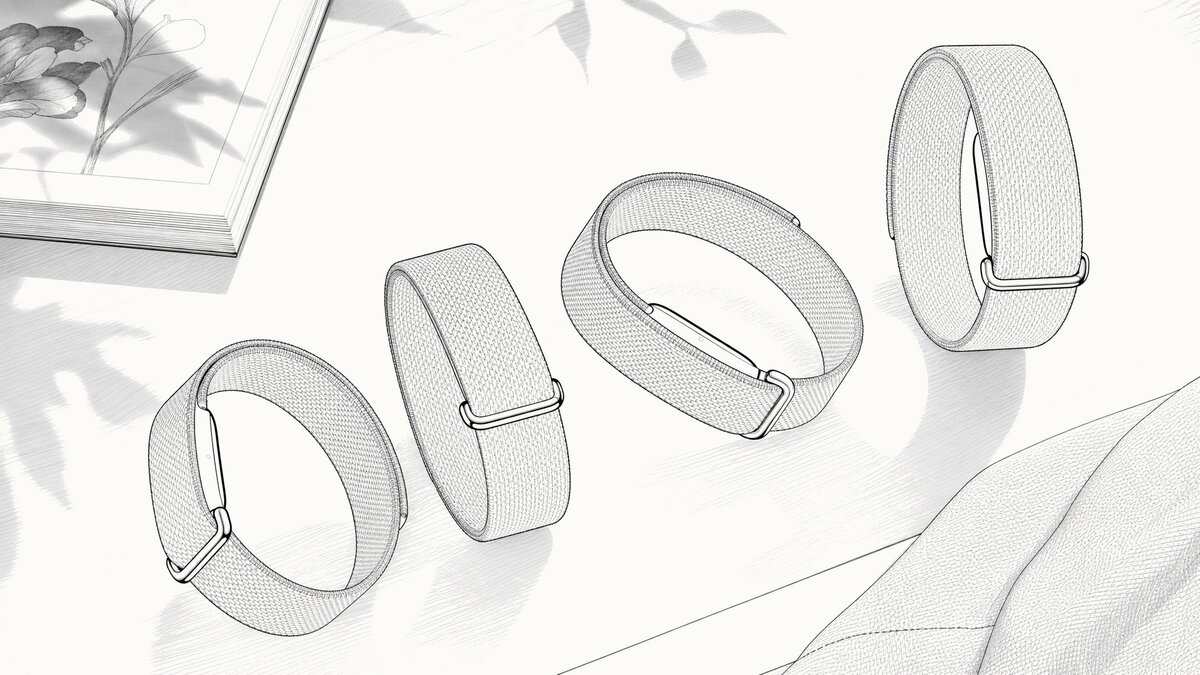
Strip out the marketing language and the Fitbit Air is a 5.2 g sensor pod with no display, attached to a band of the buyer’s choice. The pod handles 24/7 optical heart rate, SpO2, skin-temperature drift, sleep staging, and background AFib detection during sleep and stationary periods (no on-demand ECG). A three-axis accelerometer and gyroscope feed automatic workout detection. A small status light and a double-tap gesture replace the screen for the few interactions that need user input. Battery life is rated at one week, with a five-minute quick charge yielding a full day.
The pod runs on both Android and iOS — unlike the Pixel Watch, which is Android-only — which matters because the comparison set for $99 wearables includes a lot of iPhone households.
Three months of Google Health Premium are bundled with the device. Beyond the trial, Premium runs $9.99/month or $99/year, with $79/year legacy pricing preserved for existing Fitbit Premium subscribers and free access for Google One Pro/Ultra subscribers. The core tracking — heart rate, sleep, SpO2, workouts — does not require the subscription. Premium adds Google’s AI Health Coach features and richer analytics.
The WHOOP comparison
WHOOP 5.0 and WHOOP MG, relaunched in 2025, are the obvious comparison and the obvious target. Both are screenless pods worn on the wrist or upper arm, both lean on continuous physiology data, both market the same “wear it and forget it” pitch. The differences land in three places.
Sensor fidelity. WHOOP samples heart rate at 26 Hz. The Fitbit Air samples once every two seconds — roughly 0.5 Hz. That is a ~52x difference in temporal resolution. For sleep-stage classification and resting-heart-rate trending, neither device is bottlenecked there. For high-intensity interval training, sprint detection, and the recovery/strain coaching WHOOP built its brand on, the Air does not pretend to be in the same class.
Battery. WHOOP claims up to 14 days with its wireless PowerPack; the Air is a week with a small charger.
Business model. This is where the launch hurts WHOOP. WHOOP sells no hardware separately — the device is included with an annual membership at $199 (One), $239 (Peak, with the 5.0 device), or $359 (Life, with the MG device and medically-cleared on-demand ECG, irregular-rhythm alerts, and a daily blood-pressure trend estimate). The Fitbit Air sells the hardware once, for $99, and makes the subscription optional.
Three-year total cost of ownership
Subscription-versus-purchase math becomes interesting when looked at over a multi-year horizon:
| Device | Up-front | Required subscription | 3-year total |
|---|---|---|---|
| Fitbit Air (no Premium) | $100 | $0 | $100 |
| Fitbit Air + Premium annual | $100 | $99/yr | $397 |
| WHOOP One (no device upgrade) | $0 | $199/yr | $597 |
| WHOOP Peak (5.0 device) | $0 | $239/yr | $717 |
| WHOOP Life (MG device) | $0 | $359/yr | $1,077 |
| Oura Ring 4 (Silver) + annual | $349 | $69.99/yr | $559 |
| Apple Watch SE 3 (no subscription) | $249 | $0 | $249 |
| Apple Watch Series 11 (no subscription) | $399 | $0 | $399 |
The base Fitbit Air at $100 over three years is one-sixth of WHOOP Peak and less than a tenth of WHOOP Life. Even with Premium turned on, it lands well under any WHOOP tier.
The other ends of the spectrum
The Fitbit Air does not actually compete with everything WHOOP does, and vice versa.
Oura Ring 4 answers a different question: how to wear a continuous-tracking sensor invisibly. The ring form factor is genuinely unobtrusive in a way no wrist or upper-arm band is, but the hardware is three to five times the price and the subscription is required to unlock data beyond a daily score.
Apple Watch SE 3 and Series 11 answer the screen question. Notifications, payments, music, navigation, and an actual visible UI for workouts cost $249–$399 with no subscription. The health-sensor stack on Series 11 — ECG, blood-oxygen, temperature trending, sleep staging — substantially overlaps the Fitbit Air’s, with on-demand readings instead of background-only.
The screenless category is now a viable subcategory of wearable rather than a single-brand proposition. WHOOP defined it; Fitbit Air just turned it into a price-tier choice.
Bottom line
For the athlete population WHOOP serves — high-intensity training, recovery-driven programming, daily readiness scoring as a programming input — WHOOP’s higher sampling rate and the strain/recovery model around it remain the differentiated product. The Fitbit Air is not a one-for-one substitute there.
For everyone else who liked the screenless 24/7 form factor but balked at $199-and-up a year forever, Google just put out a $99 option that runs forever with no subscription required. Three years in, that’s an $1,000 swing on the Life tier and a $500 swing on Peak. WHOOP’s response will be the interesting next data point.
Sources
- Google Blog - Introducing the new Google Fitbit Air
- Google Store - Fitbit Air Tech Specs & Battery Life
- DC Rainmaker - The $99 Fitbit Air (Whoop Competitor): Everything You Need to Know!
- TechCrunch - Google unveils Whoop-like screenless Fitbit Air
- 9to5Google - Google announces $99 Fitbit Air for screen-less, all-day tracking
- 9to5Google - Fitbit Air has status light & double-tap gesture, gets Whoop size comparison
- Tom’s Guide - Forget the Whoop 5.0 — The new Fitbit Air is a screen-less, subscription-free fitness tracker
- Trusted Reviews - Fitbit Air vs Whoop: Which screenless fitness tracker should you buy?
- WHOOP - Membership Options
- Oura - Membership
- Apple - Apple Watch SE 3