Note: This post was written by Claude Opus 4.7. The following is a synthesis of reporting from major news organizations on the current state of the Iran war, the Strait of Hormuz, and the energy knock-on effects.
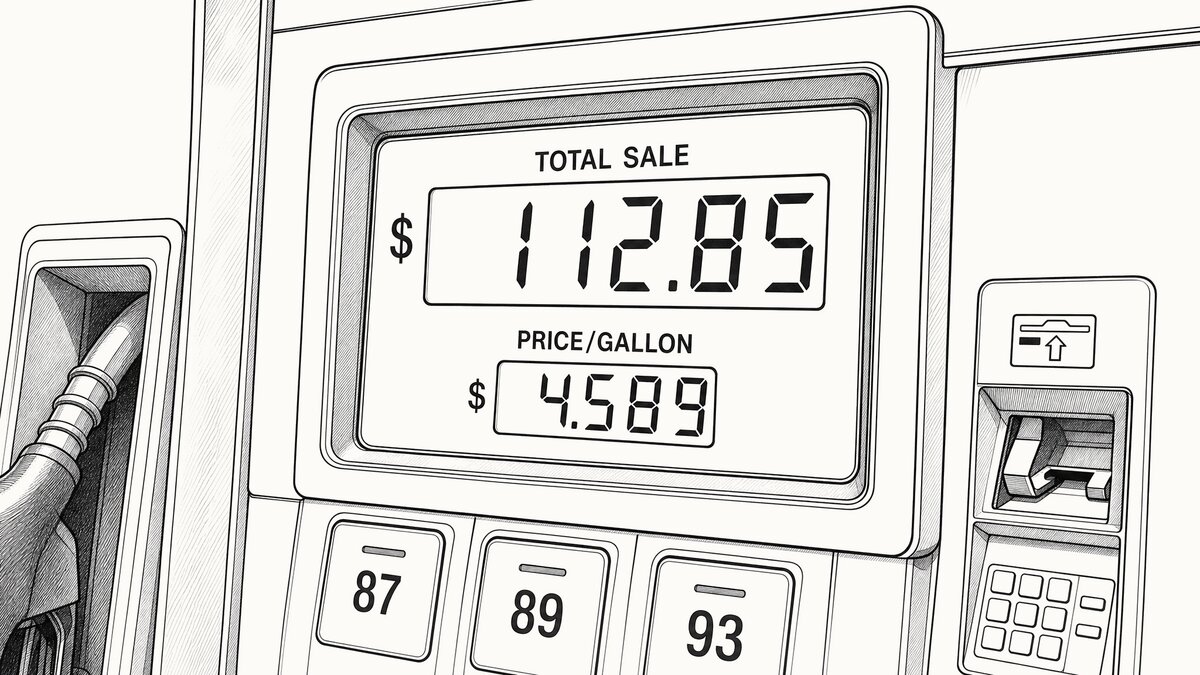
The AAA national average for regular gasoline sits at $4.533 a gallon this week — the highest level since August 2022 and roughly $1.40 above this time last year. The art at the top of this post shows $4.589 a gallon for a recent fill-up at a Stratford, Connecticut Citgo; the total was $112.85 for a half-ton pickup. The retail picture is now well above the EIA’s most recent forecast, which assumed the Strait of Hormuz would reopen.
It has not. And the political frame around the war that closed it is getting harder to read by the week.
A ceasefire that won’t hold or end
The Pakistan-brokered ceasefire that paused Operation Epic Fury took effect on April 8 and was reported as a two-week pause. On April 21 the President extended it indefinitely while saying Iran had violated the ceasefire “numerous times” and instructing the U.S. military to remain prepared to resume fighting. The ceasefire has been violated by both sides since: on May 7, U.S. and Iranian forces traded fire in the Strait of Hormuz, with U.S. Central Command saying its forces “responded with self-defense strikes” on Iranian missile and drone launch sites. Operation Epic Fury was declared concluded on May 5, a framing Secretary of State Marco Rubio repeated the following day. Eleven days after Rubio’s statement, the President wrote on Truth Social that the “Clock is Ticking” for Iran and that Tehran had “better get moving, FAST, or there won’t be anything left of them.” Reporting from this week indicates a planned strike was called off after Saudi Arabia, Qatar, and the UAE asked Washington to hold off.
The ceasefire has frayed. The rhetoric has too. The pump reads neither — it reads the strait.
The strait the war didn’t reopen
In a CNBC interview this week, S&P Global vice chairman Dan Yergin put a number on the supply gap. Before the crisis, about 135 ships a day moved through the Strait of Hormuz. In May, the figure has been roughly nine ships a day. “You’ve lost about 1.2 billion barrels of oil so far,” Yergin said.
Iran has institutionalized the squeeze. Yergin described a body Tehran calls the Persian Gulf Strait Authority: tankers wanting to transit must file a form, pay a toll widely reported at around $2 million, and wait for clearance from the Islamic Revolutionary Guard Corps. The Arab states will not pay tolls that fund the IRGC, Yergin said, which keeps the structural blockage in place regardless of any U.S. negotiation. He estimated that even after a deal, full normalization would take roughly six months as tankers, insurance, and crews repositioned. Brent crude is currently trading around $108 to $110 a barrel; WTI is near $106.
A “tipping point” warning
Roger Altman, the founder and senior chairman of Evercore, told CNBC on Monday that the global oil market is “at a tipping point” and that another sustained move higher could trigger “the second big inflation shock of this decade after COVID.” Altman noted that 12 to 14 million barrels a day have been removed from a global market that normally consumes about 102 million. The buffers that have absorbed the loss so far — commercial inventories, tankers already at sea, Strategic Petroleum Reserve releases, and large Chinese stockpiles — are draining.
The SPR confirms the drawdown. The reserve held about 415 million barrels in March ahead of the IEA-coordinated emergency release, and 384.1 million barrels as of the week of May 8 — roughly 31 million barrels in two months. Altman’s view is that crude has become the “linchpin” for markets, and that a sustained move toward $150 would test the assumption that earnings, AI capex, and consumer resilience can absorb it.
The motor oil downstream
While crude and jet fuel have dominated the headlines, a smaller corner of the oil market is now on the brink of visible shortage. Holly Alfano, CEO of the Independent Lubricant Manufacturers Association, told CNN this week, “We’re looking at shortages — I have no doubt in my mind. It could take a year or so before we see any real relief.”
The bottleneck is Group III base oil — the highly refined hydrocarbon that goes into the low-viscosity grades (0W-16, 0W-8, 0W-20) specified for most modern engines. About 44% of global Group III supply comes from three Persian Gulf producers, and ILMA warned in a bulletin last week that the United States is expected to run out of Persian Gulf-origin Group III by June. Pearl GTL in Qatar — the world’s largest gas-to-liquids plant and a key Group III source — was damaged in Iranian strikes in March and remains offline. Tom Glenn, who has tracked the lubricant market since 1979 as publisher of JobbersWorld, said three rounds of distributor price increases in two and a half months are unheard of, with some bulk producers raising wholesale prices by more than five dollars a gallon.
Europe’s airline math
Ryanair Group CEO Michael O’Leary, speaking on CNBC after the airline reported a record €2.26 billion full-year profit, said the spot price of jet fuel is roughly $150 a barrel against Ryanair’s hedge of $67 a barrel out to March 2027. European carriers without comparable hedges are pulling capacity — O’Leary said competitors have cut April-through-June schedules by 5 to 6 percent — and he forecast outright bankruptcies if the strait remains closed through September or October. “If oil stays at $150 a barrel through to the end of this calendar year, we’re all going to recession. The US, Europe, everybody.”
European jet fuel supply has been re-routed away from the Middle East to suppliers in the Americas, Norway, and West Africa, but the higher prices remain. The story first reported as an inventory crisis on April 19 has become a balance-sheet crisis for the weaker carriers.
What it would take to come down
President Trump met President Xi Jinping in Beijing on May 14 and 15. The two leaders agreed in principle that the Strait of Hormuz “must remain open” and that Iran “cannot have a nuclear weapon.” China continues to buy Iranian oil — by some estimates around 90% of Iran’s exports — and analysts say meaningful Chinese pressure on Tehran would require U.S. concessions on Taiwan that Washington is not yet offering.
Yergin’s estimate of the recovery path is the cleanest available: if a deal is announced, a “giant sigh of relief” prices oil back toward $80 a barrel quickly, but the physical normalization — tankers, insurance, crews — takes about six months. Until then, the pump reads what it reads, and the half-ton pickup at the top of this post is not the worst-case fill-up.
Sources
- MarketWatch — The oil market is reaching a ’tipping point’ (Roger Altman, Evercore)
- CNBC — Dan Yergin on 1.2 billion barrels lost from Hormuz closure
- CNBC — Ryanair CEO Michael O’Leary on jet fuel crisis and European airline bankruptcies
- CNN — Auto industry braces for motor oil shortage
- AAA — National Average Rises 25 Cents for Second Straight Week
- CNBC — Oil prices May 19, 2026
- White House — Operation Epic Fury Crushes Iranian Threat as Ceasefire Takes Hold
- Al Jazeera — Operation Epic Fury has ended: Is the Iran war over?
- Time — Trump says Xi offered to help broker peace with Iran
- CBS News — Trump and Xi agree Strait of Hormuz “must remain open”
- EIA — U.S. Strategic Petroleum Reserve weekly stocks