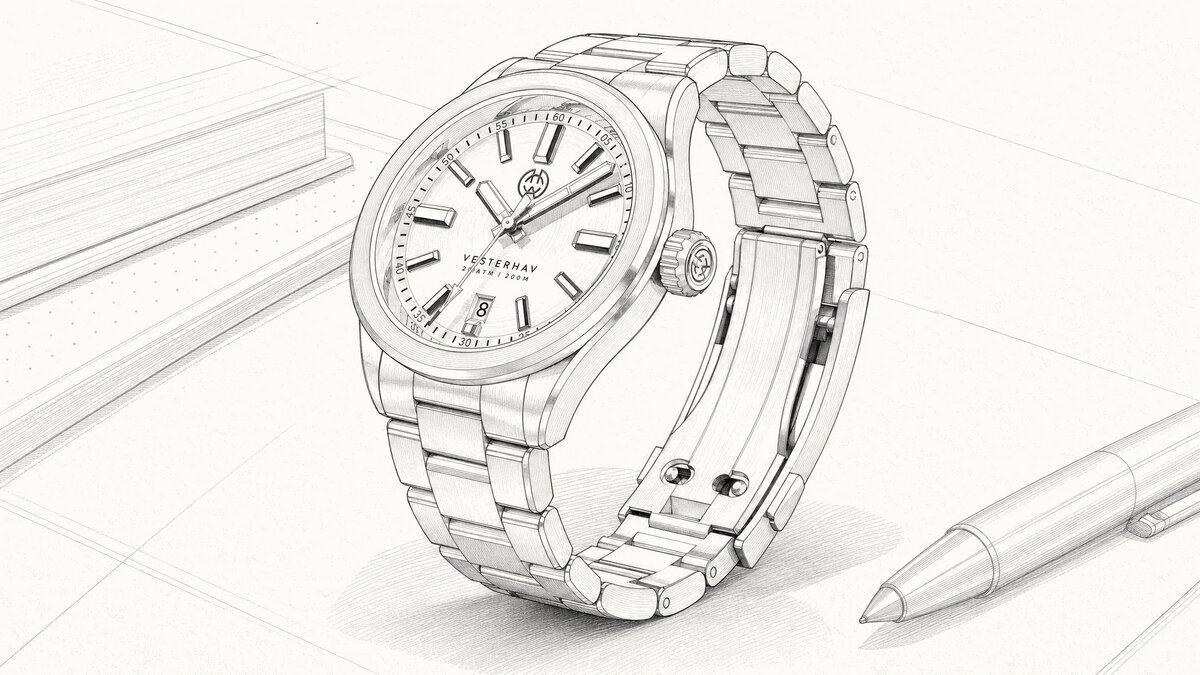
In what I hope isn’t a common experience, this watch was replaced after two weeks on my wrist. See the Addendum at the end.
I’m a watch enthusiast the same way I’m a car enthusiast, a camera enthusiast, even an AI enthusiast. I don’t have to own, wear, drive, or use them all to appreciate a nice or well-priced example. Most of the hobby, for me, is knowing what’s out there — reading the reviews, learning the movements, admiring good design from a respectful distance. And I don’t have an extravagant budget, which keeps that distance mostly intact.
This month I made an exception.
Seven and a Half Months
Since the first week of January, my working life has been two clinical application deployments running on what I still consider a really optimistic timeline. It has been a long slog. More than 200 meetings — sometimes several in a day as we approached the finish line — and a lot of work for me and for members of my team. For seven and a half months, it has basically taken over my professional and personal life.
I wanted something to mark the effort. The milestone of getting it done. A watch seemed like the right way to do that — people buy watches to mark milestones, and not just collectors. Graduations, retirements, anniversaries: a watch is the traditional object for remembering that you finished something.
To be clear about scale: this was a significant milestone for me, but it wasn’t a Rolex milestone, nor am I ever likely to be shopping in that price tier.
Red, Specifically
The primary software vendor on this project is known for its red logo. The shade has been on a journey of its own over the years. In 2020 it was a bright, stop-sign red. Today it’s a deep oxblood sitting right at the edge of black. Black cherry, if you’d rather. The last inch of a bottle of Cabernet.
Anyway, I’d been keeping an eye out for watches with red dials — anywhere from stop-sign red all the way down to the darkest oxblood.
A Microbrand From Denmark
Somewhere along the way, Henry Archer came to my attention — a family-run microbrand out of Aarhus, Denmark, founded by Henrik Schødt. Specifically, their Vesterhav in crimson red, at a current list price of $599.
A microbrand, if the term is new to you, is a small independent company that designs its own watches, has them built in limited quantities, and sells directly to buyers rather than through jewelry counters. Cutting out the retail margin is a big part of how a piece like this lands at $599 instead of a multiple of it.
No Battery, No Firmware
The Vesterhav is a mechanical automatic, and that deserves a plain-English explanation if you’ve never owned one. There is no battery in this watch. It runs on a coiled mainspring, and a weighted rotor inside spins with the motion of your wrist, continually winding that spring while you wear it. Wear it daily and it never stops. Leave it on the dresser and it will run about 42 hours before winding down; pick it up Monday morning, give the crown thirty turns, set the time, and you’re back in business.
The regulating mechanism inside — the balance — swings 28,800 times an hour, eight beats every second. That’s why the second hand appears to glide around the dial instead of jumping once per second the way a quartz watch does. It’s a defiantly traditional machine at a moment when smartwatches are among the most popular watches on Earth. I get the appeal of a computer on the wrist; I work in IT. But there’s something to an instrument that does exactly one job and does it with an architecture that predates the light bulb. It isn’t maintenance-free — a mechanical needs periodic service to keep running. Still, it will never ask me to install a routine security update the way a smartwatch does, and nobody will ever announce an end-of-support date.
The case back is sapphire glass — an exhibition back — so the movement is right there to look at: the rotor swinging on its bearing, the balance blurring away. That movement is a Miyota 9015, made by Citizen in Japan, a workhorse caliber that small brands have relied on since 2009. It’s thin — 3.9 mm — which is a big part of how the Vesterhav manages 200 meters of water resistance in a case only 10.45 mm tall. It’s also inexpensive enough that when service eventually comes due, swapping in a fresh 9015 may cost less than overhauling the old one.
The rest of the specification sheet reads better than the price suggests:
| Spec | Vesterhav |
|---|---|
| Case | 40 mm diameter, 47 mm lug-to-lug, 316L stainless steel |
| Thickness | 10.45 mm |
| Movement | Miyota 9015 automatic, 28,800 bph, roughly 42-hour power reserve |
| Crystal | Sapphire front and back, 6-layer anti-reflective coating |
| Water resistance | 200 meters / 20 ATM, screw-down crown |
| Bracelet | Tapers from 20 mm to 16 mm, screw-together links, milled clasp with tool-free micro-adjust |
| Lume | Super-LumiNova — white in daylight, ice-blue in the dark |
| List price | $599 |
Around 50 at a Time
Henry Archer says on its own site that it often manufactures around 50 pieces per color variant in each batch. As I write this, the crimson listing shows seven left.
That reframes rarity in a way I find entertaining. Rolex and Omega are the aspirational names, but they produce at industrial scale, and you can find them on display behind glass in any decent-sized city. A crimson-dial Vesterhav, by the brand’s own math, exists in batches of a few dozen at a time. In practical terms — the odds of ever seeing one on another wrist in the northeast US — it’s a lot rarer than the pieces people wait years for.
Ordering One
I pre-ordered on August 1st; the crimson dial wasn’t in stock at the time. A first-time buyer discount took 10% off, so my final cost was $539.10. For US shoppers, the price on the screen is all-inclusive of tax, tariffs, and shipping — which, in 2026, is not a small consideration.
A shipping label was created in Denmark on August 11th, and the watch was delivered to my office in Connecticut on August 14th — the Friday of the week our applications went live with the final integrated site. The timing was pretty terrific.
A Week on the Wrist
I’ve worn the crimson Vesterhav every day for just over a week now, and I’ve been extraordinarily pleased with it. The 9015 seems great so far — the second hand’s travel is very smooth. It wears well, too: at 40 mm across and 10.45 mm thick, it’s properly sized without being big on an adult male’s 7¾-inch wrist. I like the Oyster-style three-link bracelet, and I especially like that the adjustment links use micro screws rather than push pins. Removing three links from the factory bracelet got the fit exactly right. Sizing took me about five minutes, though admittedly I had the correct screwdriver — the links take a 1.2 mm blade — and I’ve done this before. The links appear machined rather than stamped, which is not a given at this price.
The design feels original, not an homage to any well-known model. The closest thing I’ve seen to it visually is the Omega Seamaster Aqua Terra in 38 mm with the terracotta dial — a similar depth of red — but the hands and hour markers don’t match, the bracelet is another design entirely, and the price tag is $7,400. Too rich for this occasion, and completely unnecessary.
Every time I look at my crimson red Vesterhav, I’m reminded of what we endured and mostly overcame this year. There’s nothing about this watch that I don’t enjoy. It’s my new favorite — well worth the discounted $539.10 I paid, and it would have been worth the full $599. My thanks to Henry Archer for delivering a nice watch at an equally nice price.
Addendum
Exactly two weeks after this watch arrived, the rotor came off its bearing and was loose inside the case. I contacted Henry Archer that afternoon, dropped it at DHL the next morning, and four days later they emailed to say a brand-new watch was shipping the same day, fitted with my original bracelet. UPS and U.S. customs then took nine days to get it to Connecticut, but the replacement was on my wrist exactly two weeks after the rotor fell off, at no cost to me beyond a Saturday-morning drive to the DHL office. It hasn’t changed my opinion of the Vesterhav. The full story is in My Henry Archer Warranty Experience: A New Watch in Two Weeks.