On February 25th at 9:10 in the morning, I stopped at a Sheetz along I-70 in Huber Heights, Ohio, and filled up at $2.499 a gallon. The price was low enough that I took a photo. Oil was sitting comfortably between $60 and $70 a barrel. Nobody was talking about gas prices.
Three days later, the United States began bombing Iran.
The Nickel-a-Day Climb
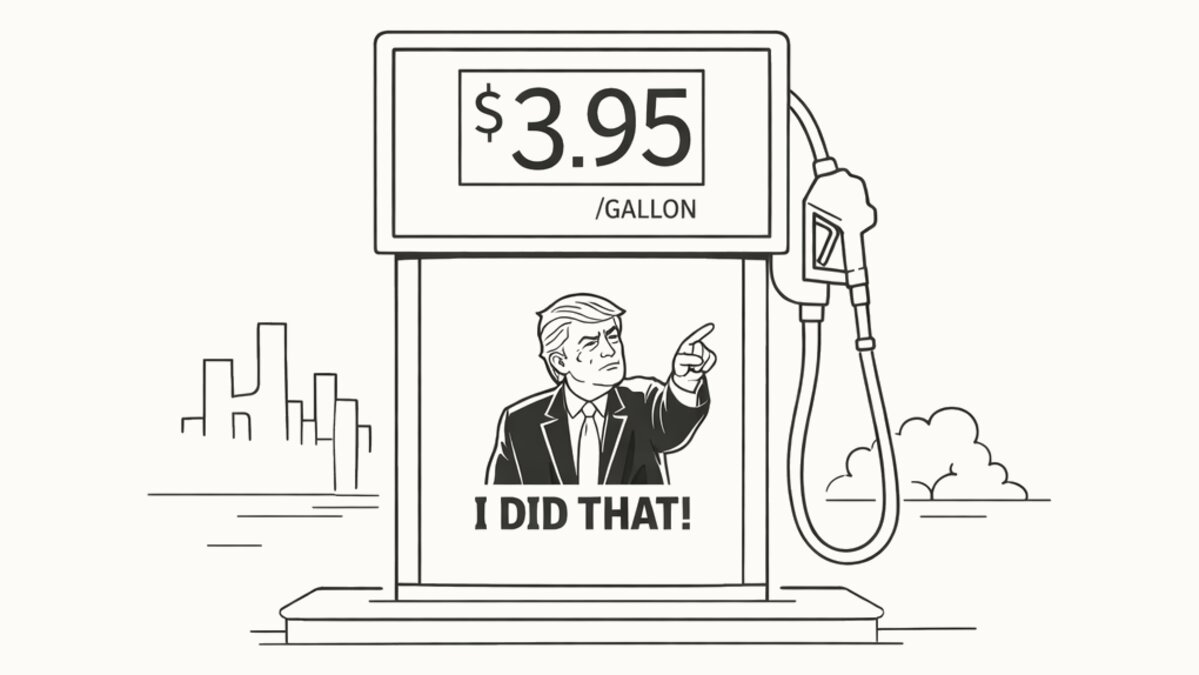
Since the strikes began on February 28th, I’ve watched the price at my local pumps in Connecticut rise by roughly a nickel almost every day. This morning it was $3.95. The national average hit $4.06 — up more than a dollar from $2.98 just one month ago. Diesel has pushed past $5.00 for the first time since 2022. Jet fuel is up 85%.
That $2.499 gallon in Ohio feels like it belongs to a different era. It was 35 days ago.
Twenty Percent of the World’s Oil
The Strait of Hormuz — a narrow channel between Iran and Oman — carries roughly 20% of the world’s oil supply, about 20 million barrels a day. Since early March, it has been effectively closed to commercial tanker traffic. Iran imposed a de facto blockade after the strikes began, and insurers pulled coverage for vessels attempting the transit.
The Dallas Fed describes this as the largest disruption to global energy supply since the 1970s oil crisis. WTI crude crossed $100 a barrel on March 30th — its best monthly gain since May 2020. Brent crude posted its strongest monthly rally since 1988.
Former Secretary of State John Kerry, speaking at a conference in Texas, put the logistics bluntly: “Ships that escaped the Strait of Hormuz before [the war] began have reached port. They’re empty now.”
The Nightmare Scenario
White House officials are bracing for worse. According to Politico, the administration now treats $100 a barrel as the new baseline — and has not ruled out $200. Stephen Moore, a former Trump economic adviser, called crude exceeding $150 a barrel a “nightmare scenario,” adding that “the president is now really focused on getting that down as quickly as possible.”
The numbers behind the scenarios are sobering:
| Scenario | Oil Price | Est. Gas Price |
|---|---|---|
| Current (April 1) | ~$100/barrel | ~$4.06/gallon |
| War continues through May | $150/barrel | ~$5.00/gallon |
| Hormuz closed into June | $200/barrel | $6.00–$7.00/gallon |
Jason Bordoff of Columbia University’s Center on Global Energy Policy offered the starkest assessment: “There is no policy option to prevent oil prices from marching up toward $200 a barrel if the Strait of Hormuz remains closed.”
The president’s own take on reopening the strait: “At a certain point it will open itself.”
Countries Are Already Running Out
The disruption isn’t hypothetical for everyone. Bangladesh is staring at single-digit days of fuel reserves. The country’s Eastern Refinery holds roughly 80,000 tonnes of crude — enough for 17 to 18 days. Octane stocks may last nine. Nearly all of Bangladesh’s crude imports come from Saudi Aramco and Abu Dhabi National Oil Company via long-term agreements — every barrel transiting the Strait of Hormuz.
Universities have been shut. Fuel sales have been rationed. Long queues have formed at petrol stations. The government is scrambling to source emergency shipments from Singapore, Malaysia, Nigeria, and Australia at prices nearly 2.5 times what they were paying in early March.
The Philippines declared a national energy emergency on March 25th. Ninety percent of its oil comes from the Middle East.
No Good Options
Oil analyst Rory Johnston told Politico that rising fuel costs amount to “effectively a massive tax that will sap excess disposable income. It will hit poor households in a much larger way.” Energy economist Philip Verleger was more succinct: “The costs of all products will rise.”
White House spokesperson Taylor Rogers emphasized that “America enjoys record-high domestic oil and gas production.” That’s true — but domestic production doesn’t set global prices. When 20% of the world’s supply is locked behind a naval blockade, American rigs can’t pump fast enough to close the gap.
The Eurasia Group puts the probability of this war dragging into May at 55%. Macquarie warns that if fighting extends into June, $200 oil is on the table. Goldman Sachs estimates that current prices already include a $14 to $18 per barrel geopolitical risk premium.
I paid $2.499 a gallon five weeks ago. This morning it was $3.95. I’m not sure what it’ll be on my drive home.