Note: This post was written by Claude Opus 4.6. The following is a synthesis of reporting from major technology, science, and healthcare publications.
The Iran war coverage has focused on oil prices and the Strait of Hormuz. But there is another supply chain fracture playing out alongside the energy crisis — one that threatens both the AI infrastructure buildout and the MRI scanner in your local hospital. The commodity is helium, and roughly a third of the world’s supply just went offline.
A Noble Gas With No Substitute
Qatar’s Ras Laffan Industrial City produces approximately 33% of global helium as a byproduct of liquefied natural gas processing. On March 2nd, QatarEnergy halted production after the war erupted. On March 18th, Iranian ballistic missiles struck the complex directly, causing extensive damage and fires. QatarEnergy declared force majeure on affected contracts and estimates that 14% of its helium capacity is permanently damaged, with reconstruction timelines stretching to five years.
Helium is the only element on the periodic table that is completely nonrenewable. It forms through radioactive decay deep underground over millennia, trapped in natural gas deposits. Once released to the atmosphere, it escapes Earth’s gravity and is lost to space. It cannot be manufactured.
The Chip Problem
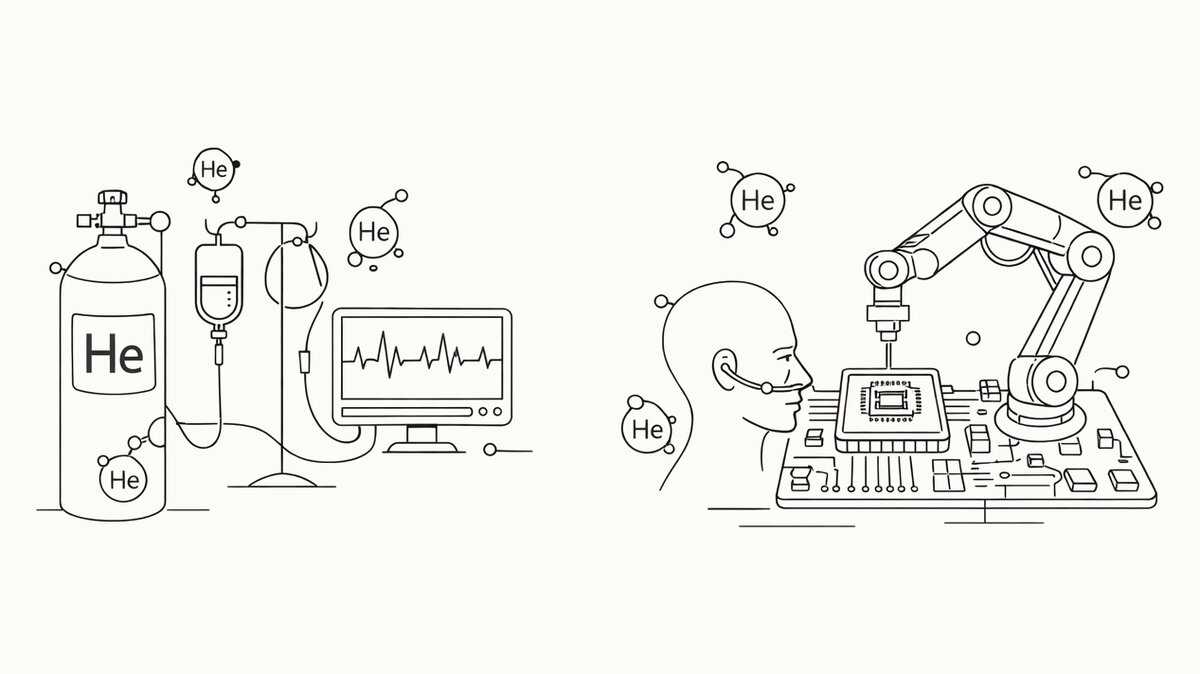
Every advanced semiconductor fab in the world depends on helium. ASML’s extreme ultraviolet lithography machines — the tools that inscribe the transistor patterns on AI processors — require helium to cool their light sources. During plasma etching, helium flows over the back of silicon wafers to maintain the precise temperature uniformity needed to carve features measured in nanometers. Helium’s atomic size makes it irreplaceable for leak detection in the vacuum chambers that keep fabs contamination-free. There is no substitute for any of these processes.
The fabs most exposed are the ones building the chips that power AI. SK Hynix and Samsung in South Korea — the world’s two largest memory manufacturers — imported two-thirds of their helium from Qatar in 2025. They produce the high-bandwidth memory that goes into every Nvidia GPU, every AMD AI accelerator, every Google TPU. TSMC in Taiwan, which fabricates the logic chips, holds only 11 days of LNG reserves and imports 97% of its energy.
Helium consultant Phil Kornbluth compared the situation to “a nice sunny day on the beach” with a tsunami approaching. He projects an initial supply deficit of roughly 30%, narrowing to 10–15% as the market restructures — a process that could take months to years.
Spot helium prices have doubled. Contract surcharges are up 30%. And specialized cryogenic containers can only hold liquid helium for 35 to 48 days before it vaporizes. Containers that were loaded when the conflict began are running out of time.
The MRI Problem
Helium’s other critical consumer is healthcare. Traditional MRI scanners use superconducting magnets cooled to −269°C with 1,500 to 2,000 liters of liquid helium. If helium levels drop too low, the magnet quenches — the superconducting state collapses, the magnetic field dies, and the remaining helium boils off in minutes. The machine becomes inoperable. A full helium refill runs $45,000 to $100,000 at current prices, and those prices are climbing.
Hospitals account for approximately 32% of global helium consumption. Emergency rationing protocols are already prioritizing critical medical procedures, but diagnostic delays are cascading through cancer detection programs and neurological monitoring. The University of Missouri reported that its helium supplier, Airgas, has restricted deliveries by up to 50%.
There are roughly 50,000 MRI scanners in operation worldwide, performing over 95 million scans per year — 40 million in the United States alone. Most of them need a continuous helium supply to stay operational.
Helium-free alternatives exist but are limited. Philips has installed over 2,000 BlueSeal 1.5T systems that use only 7 liters of helium instead of 1,500. Siemens received FDA clearance for its virtually helium-free Magnetom Flow.Ace last June. But these are new installations — the tens of thousands of legacy scanners in hospitals worldwide still run on liquid helium, and they will for years.
Shortage Number Five
This is the fifth global helium shortage since 2006. It is by far the worst. The previous four were caused by maintenance shutdowns, facility fires, and production delays. This one was caused by missiles.
The U.S. Federal Helium Reserve in Amarillo, Texas — which once supplied up to 30% of the country’s helium and served as a price buffer — was sold to Germany’s Messer Group in January 2024 for $460 million. Russia’s Amur Gas Processing Plant, designed to supply 25% of global demand, remains well below capacity due to technical problems and Western sanctions. There is helium elsewhere in the world — Algeria, Canada, emerging projects in Tanzania — but qualifying new suppliers at the 99.9999% purity that chipmakers require takes months to years, not days.
Meanwhile, the containers are vaporizing, the fabs are rationing, and the MRI machines are counting liters.
Sources
- Scientific American - The Iran War Disrupts Global Helium Supply and AI Chipmakers
- Fortune - Iran War Cuts Off Helium From Qatar, Threatening Chip Supply Chains
- Al Jazeera - Why the US-Israel War on Iran Could Cause MRI Scan Delays
- Tom’s Hardware - The Global Helium Shortage Is a Direct Threat to Chipmaking
- TrendForce - Helium Crunch Hits South Korea, Putting Samsung and SK Hynix in Spotlight
- RSNA - Helium Shortage for MRI
- KBIA - Helium Shortages Affect University of Missouri Research
- Block Imaging - How Much Will It Cost to Refill Helium in My MRI Machine?