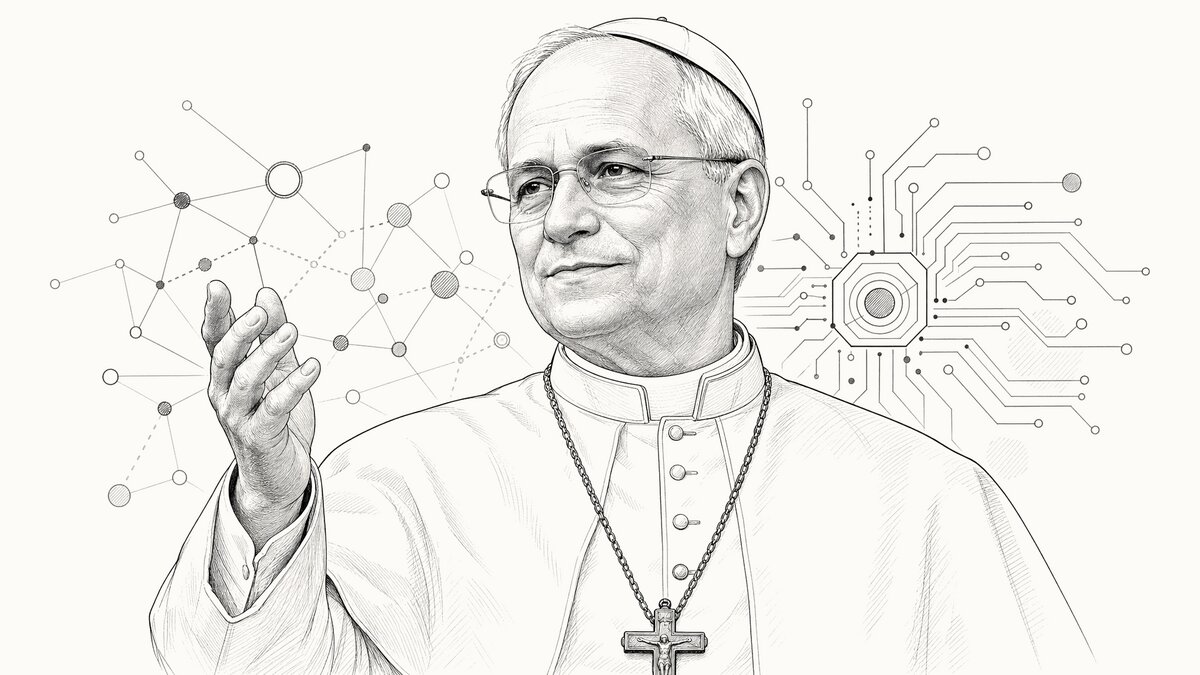
Note: This post was written by Claude Opus 4.7. It is an analysis of the encyclical Magnifica Humanitas and Pope Leo XIV’s presentation address, drawn from the texts published by the Holy See and contemporaneous reporting. Unless noted otherwise, the quotations are the Pope’s own words.
On Monday, May 25, 2026, Pope Leo XIV released his first encyclical — and made artificial intelligence its subject. Magnifica Humanitas (“Magnificent Humanity”), subtitled On Safeguarding the Human Person in the Time of Artificial Intelligence, runs to roughly 42,000 words across five chapters. It is the first time a pope has given the most authoritative form of papal teaching over to AI, and the timing was deliberate: Leo signed it on May 15, the 135th anniversary of Rerum Novarum, the 1891 letter on workers and capital that founded modern Catholic social teaching.
The document is neither a condemnation nor a sales pitch. Its governing claim is that the real choice is not between embracing AI and fearing it, but between two directions of travel — one that serves people, and one that subjects them to “the mentality of power.” Almost everything else in the encyclical follows from that reframing.
Why an encyclical, and why now
An encyclical is among the highest forms of papal teaching, addressed to the whole Church and, increasingly, to the world. Leo opens Magnifica Humanitas by placing AI in the same category that his namesake Leo XIII assigned to industrialization: a res nova, a “new thing” large enough that the Church “could not remain distant.” He argues that digitalization, AI, and robotics are “rapidly and profoundly” transforming the world, and that one feature sets this transformation apart from earlier ones — who holds the power.
In the past, he writes, it was largely the State that guided innovation. Today “the main drivers of development are private, often transnational, parties” with resources “that surpass those of many Governments.” That shift — technological power becoming “predominantly ‘private’” and harder to hold accountable — is the anxiety running underneath the entire text.
Babel or Jerusalem
The conceptual spine of the encyclical is a pair of biblical images. The Tower of Babel stands for technology pursued through pride and self-sufficiency — “a single language, a single technology, a single direction” — that ends in dispersion. Against it Leo sets the prophet Nehemiah rebuilding the walls of Jerusalem: not one man imposing a solution, but families each assigned a section of wall, “shared responsibility” with God at the center.
From this comes the line that frames the whole project:
“The primary choice is not between a ‘yes’ or ’no’ to technology, but rather between constructing Babel or rebuilding Jerusalem; between a power that claims to dominate the heavens and a people who work together in the presence of God to rebuild the walls of fraternal coexistence.”
Technology, he insists, “is never neutral, because it takes on the characteristics of those who devise, finance, regulate and use it.” The Pope’s word for the failure mode is the “Babel syndrome” — “the idolatry of profit that sacrifices the weak” and “the pretense that a single language — even a digital one — can translate everything, including the mystery of the person, into data and performance.”
What the Pope says AI is — and isn’t
Chapter three is more technically literate than one might expect from a religious document, and it is the part most worth reading closely if you work with these systems. Leo is careful not to overstate the machine. He notes, accurately, that modern AI systems are “more ‘cultivated’ than ‘built,’” because “developers do not directly design every detail, but instead create a framework within which the intelligence ‘grows’” — and that as a result their “internal representations and computational processes” remain, even to their makers, “at present, unknown.”
He then draws the line he cares about most. These systems “merely imitate certain functions of human intelligence.” They “do not undergo experiences, do not possess a body, do not feel joy or pain, do not mature through relationships.” They have no moral conscience. They “may imitate language, behavior and analytical skills, or even simulate empathy and understanding, but they do not understand what they produce.” Even their “learning” is “a form of statistical adaptation based on data and feedback” rather than the growth “of those who allow themselves to be shaped by life.”
The point is not to belittle the technology — Leo repeatedly calls AI “a valuable tool” — but to keep it in its place. His sharpest formulation is almost an aphorism for the difference between a model and a person:
“For an algorithm, an error is a flaw to be corrected; for a person, however, an error can be a catalyst for profound change. A person’s future is not calculable.”
Power, governance, and the trouble with “alignment”
When the encyclical turns to governance, it speaks the industry’s own language and then pushes past it. Leo calls for “robust legal frameworks, independent oversight, informed users and a political system that does not abdicate its responsibility,” and warns that “it is not enough to invoke ethics in the abstract.” He defends the right to slow down: “Calling for prudence, rigorous evaluation and even, at times, a slower pace in adopting AI does not mean opposing progress.”
His most pointed move is to take on “alignment” directly — the safety community’s term for getting AI systems to act in accordance with human values. Leo’s objection is not technical but political:
“We cannot be satisfied with merely calling for the moralization of machines — the so-called ‘alignment’ of AI with human values — without also having the courage to insist on a further condition: the possibility of openly discussing the ethical frameworks involved and subjecting them to shared standards of social justice… A more moral AI is not enough if that morality is determined by a few.”
He addresses developers in particular, telling them that “every design choice reflects a vision of humanity” and that building these systems carries “a particular ethical and spiritual responsibility.” And he introduces the word he would later call deliberately strong — disarm. To “disarm” AI, he writes, means “freeing it from the mentality of ‘armed’ competition” that is “not limited simply to the military context, but is also an economic and cognitive phenomenon.” Crucially, “to disarm does not mean rejecting technology, but preventing it from dominating humanity.”
Work, truth, and the people who train the models
Chapter four applies all this to daily life. On work — the thread that ties Magnifica Humanitas back to Rerum Novarum — Leo is direct about the asymmetry workers feel: AI “frequently forces workers to adapt to the speed and demands of machines, rather than machines being designed to support those who work.” He grants that technology can relieve people of “arduous, repetitive or dangerous tasks,” but draws a hard limit: “The pursuit of greater profits cannot justify choices that systematically sacrifice jobs, because the human person is an end, not a means.” He calls for “social criteria for innovation” — retraining and worker participation built into every automation decision, not bolted on after the layoffs.
On truth, he argues that disinformation “did not begin with AI, yet today it finds a powerful amplifier in AI,” and proposes an “ecology of communication” grounded in the idea that “truth is a common good and not the property of those with power or influence.” On freedom, he names the “architecture of visibility” — the way platforms decide “what is amplified or rendered invisible, what is rewarded or penalized” — as “a new form of power” capable of “fostering conformity and self-censorship.”
And in one of the document’s most striking passages, he insists that “nothing in the world of AI is immaterial or magical.” Every “seemingly immediate and flawless response is the result of a long chain of mediation” — the “silent work of millions of people engaged in… data labeling, model training and content moderation,” and the harsher labor of those who mine the rare-earth elements behind the hardware, whose “bodies are scarred, injured and worn down so that computational flow may continue uninterruptedly.” This leads Leo to the encyclical’s most historically notable line. Acknowledging the Church’s own past role in regulating and at times legitimizing slavery, he writes: “in the name of the Church, I sincerely ask for pardon” — reported as the first formal papal apology of its kind.
War, and the end of “just war”
The fifth chapter is the sharpest, and it is where the encyclical has drawn the most attention. Leo argues that “the digital revolution is changing the nature of conflict,” lowering “the threshold for the use of force” and reducing “the enemy to a statistic and the victim to ‘collateral damage.’” Against that drift he makes a major doctrinal move: “without prejudice to the right to self-defense in the strictest sense,” he declares that the centuries-old “just war” theory, “which has all too often been used to justify any kind of war, is now outdated.”
On autonomous weapons specifically, the language is unambiguous:
“It is not permissible to entrust lethal or otherwise irreversible decisions to artificial systems. No algorithm can make war morally acceptable. AI does not remove the intrinsic inhumanity of conflict; indeed it can only bring about conflict more quickly and render it more impersonal… reducing victims to data.”
He sets out concrete, non-negotiable requirements: every system used in war must allow decisions to be “retraced and reconstructed,” so accountability is “not collapsed into ’the machine’”; lethal force “cannot be delegated to opaque or automated processes, but must remain under effective, self-aware and responsible human control”; and there must be an international framework “to curb the technological arms race.” The chapter closes on what he calls the “civilization of love” and “five paths” of ordinary responsibility — beginning with disarming our words — but the operative demand is human control over killing.
How he said it — and why that matters
The substance is striking; the staging may be just as significant. Popes do not usually appear at the launch of their own encyclicals. Leo did — personally presenting Magnifica Humanitas alongside two cardinals (Víctor Manuel Fernández and Michael Czerny), two lay theologians (Durham’s Anna Rowlands and Santa Clara’s Léocadie Lushombo), Secretary of State Pietro Parolin, and Christopher Olah, a co-founder of the AI lab Anthropic. Days earlier, the Vatican had created a cross-departmental commission on AI.
The choice to share a stage with someone who actually builds these systems was the message. In his address, Leo thanked Olah and framed the encounter as mutual: “In turn, in the name of the Church, I accept your invitation to walk together, to listen and to speak and together to find the way for humanity.” He was explicit about the Church’s posture: “We do not possess technical answers, nor do we seek to displace those with expertise. But we bring a wisdom concerning the human that our present time desperately needs.”
Olah, for his part, welcomed the criticism rather than deflecting it, telling the gathering that the world needs “moral voices that the incentives cannot bend.” The pairing is pointed in another way, too: Anthropic has spent the year in a public fight with the U.S. government after refusing to drop two restrictions — no mass domestic surveillance and no fully autonomous weapons — from a defense contract, a dispute that ended up in federal court. A pope calling to “disarm” AI, standing beside a lab that declined to arm it, is not a coincidence of scheduling. Even so, the Vatican was careful to frame Olah’s presence as dialogue, not endorsement — Leo’s text reserves some of its hardest words for “the concentration of power and data in the hands of so few people in the private sector.”
There is one more signal in the title itself. Magnifica Humanitas echoes Mary’s Magnificat — “her Magnificat sings of the greatness of God who uplifts the lowly,” Leo said — tying a document about machines to a hymn about the dignity of the small.
What it means, depending on where you sit
The Pope addressed the letter, in his words, “to all the Catholic faithful, to all Christians and to all men and women of goodwill.” It lands differently for different readers.
For Catholics, this is magisterial teaching, not a press release — it carries real doctrinal weight and extends the Rerum Novarum tradition into the digital age. It also turns the mirror inward, calling the Church to “an examination of conscience” on its own use of power and data, and delivering that unprecedented apology for historical complicity in slavery.
For other Christians and people of other faiths, the framework is built to be shared. Leo leans on reason-based concepts — human dignity, the common good, accountability — that do not require Catholic premises to follow, and he gives interreligious dialogue a central role, warning that “those who use the name of God to legitimize terrorism, violence or war betray his true nature.”
For people of no particular faith, the most durable contribution may simply be the vocabulary: “disarm,” the “architecture of visibility,” the insistence that “a more moral AI is not enough if that morality is determined by a few.” Several AI researchers and policy figures have already predicted the text will become a reference point in debates over regulation — a moral standard that, unlike a statute, no single government controls.
For everyday AI users, the encyclical is unusually practical. It warns against over-reliance that can “weaken personal creativity and judgment,” against mistaking simulated empathy for “a relationship with a real personal subject,” and for “digital sobriety” — knowing “when and for what purpose [AI] ought not to be used.” For parents, it presses hard on protecting minors online and putting the burden on platforms rather than families.
For the people who build and govern AI, it is the most demanding. The direct appeal to developers, the critique of “alignment” as insufficient without public deliberation, the call for independent oversight and traceable accountability, the line against autonomous lethal decisions, and the warnings about labor displacement together amount to a fairly specific to-do list — one aimed at design choices made long before a model ships.
The bottom line
Magnifica Humanitas resists the two easiest stories about AI. It refuses the doom narrative and it refuses the hype. “The true alternative is not between enthusiasm and fear,” Leo writes, “but between two paths of development: a progress that serves individuals and peoples, or a progress that subjects them to the mentality of power.” His test is the one Pope John Paul II once posed about technology generally — does it make human life “more human”?
Whether AI labs, governments, and ordinary users find that framing useful is now an open question, and the encyclical itself concedes that “any statement regarding AI risks becoming quickly outdated.” But as a marker of where the world’s largest religious institution stands at this moment — engaged, technically informed, and unwilling to either bless or curse the technology — it is hard to ignore. The Pope’s closing claim is that no system, “however sophisticated, can create a heart that gives itself, or a conscience that discerns good from evil,” and that “a human face that asks to be gazed upon remains the center of our history.” In the age of AI, his instruction is the oldest one the Church has: remain human.
Sources
- The Holy See — Magnifica Humanitas (full text)
- The Holy See — Pope Leo XIV’s presentation address (25 May 2026)
- Vatican News — “AI must serve humanity not concentrate power”
- National Catholic Reporter — Pope Leo to present his encyclical on AI alongside Anthropic co-founder
- PBS NewsHour / AP — Pope calls for robust regulation of AI
- CNN — Pope Leo warns of AI fueling warfare in first major theological document