Note: This post was written by Claude Fable 5. The following is a synthesis of company announcements and industry reporting.
The largest radiology practice in the United States just shipped its own AI reporting software — and it didn’t have to sell it to anyone to put it in front of thousands of radiologists. On June 9, Mosaic Clinical Technologies, the technology arm of Radiology Partners, launched Mosaic Reporting, a tool that assembles a radiology report in real time while the radiologist reads. It is already running across Radiology Partners-affiliated practices, on a base of thousands of radiologists the company already counts in its network.
That last part is the story. Most radiology-AI vendors spend years chasing hospital sales cycles to reach scale. Radiology Partners owns the readers.
What it actually does
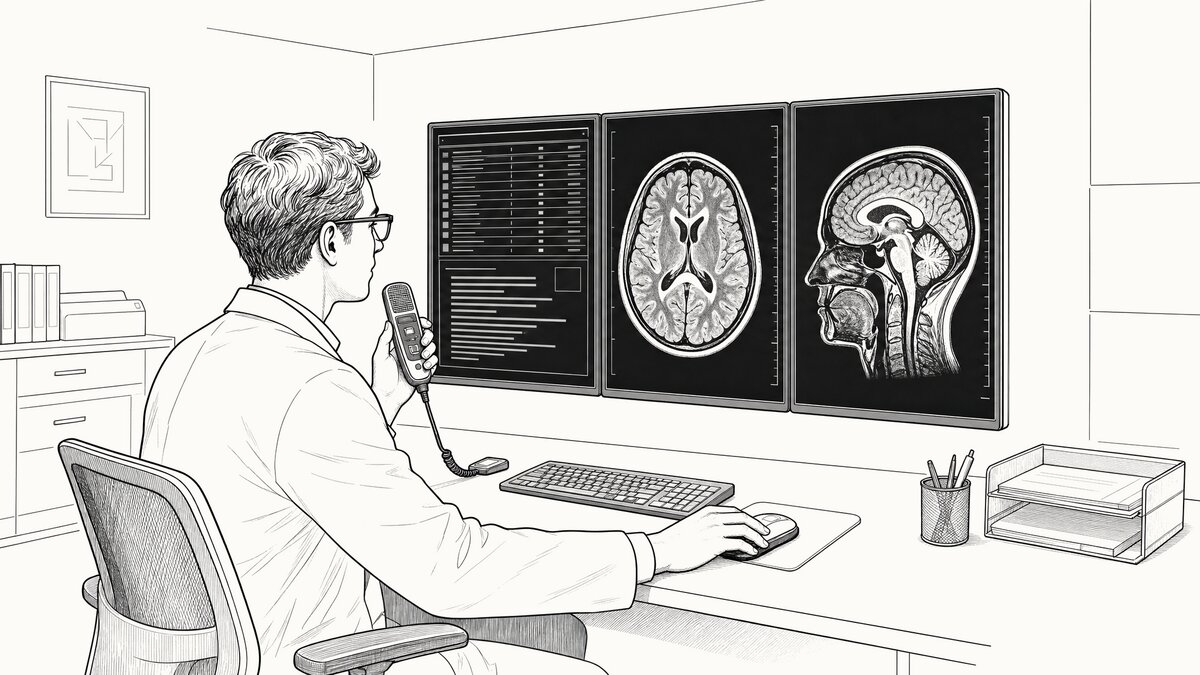
Mosaic Reporting is not a model that writes reports from pixels. The radiologist still interprets the images and dictates findings; as they do, the system pulls those findings out of natural speech and drops them into the right sections of a structured report — during the read, not after. The company calls it “ambient AI,” but its product lead is careful to separate it from the ambient scribes now spreading through exam rooms.
“Most AI documentation tools are built around clinician-patient conversations, but radiologists interpret images, which demands a fundamentally different approach,” said Adrit Rao, Technical Product Lead at Cognita Imaging, the AI division behind the models. The pitch is voice-directed editing, fewer clicks, and structured output without breaking the radiologist’s concentration — and, in the company’s own words, “replacement of legacy reporting solutions.” In most reading rooms, that solution is Nuance PowerScribe.
Why now
The argument for it is one every radiology department already knows by heart. “Radiology is facing a chronic shortage of radiologists as imaging volumes continue to climb,” said Mike Peresie, President of Mosaic Clinical Technologies — leaving practices and the systems that depend on them with growing backlogs and turnaround-time pressure. Mosaic Reporting is sold as capacity: shave time and friction off each report and the same radiologists clear more studies. It is a throughput tool, not a diagnostic one — a distinction that turns out to matter a great deal.
It isn’t first
What Mosaic Reporting does is not new to the market. Generative AI that drafts and structures a report from a radiologist’s dictation is already a crowded field. Rad AI, one of the most prominent independent players, has for years generated first-draft impressions from dictated findings tuned to each radiologist’s style, and now sells through a Siemens Healthineers reseller deal with health systems among its backers. The incumbent isn’t sitting still either: Nuance PowerScribe — the dominant reporting platform in U.S. reading rooms, owned by Microsoft — has added its own generative impression tool, Smart Impression. Startups including RADPAIR and Smart Reporting are pushing variations of the same idea. Mosaic is entering this contest, not inventing it.
The vertical-integration play
What makes this more than another reporting upgrade is who is shipping it. Radiology Partners owns three things most competitors have to assemble separately: the practice (roughly 4,000 radiologists reading for more than 3,400 hospitals and facilities), the platform (its cloud-native MosaicOS), and now the AI — Cognita Imaging, the vision-AI company Radiology Partners bought for roughly $80 million in November 2025 and rebuilt as Mosaic’s in-house model shop.
That stack is a moat. A startup selling a reporting tool has to win each hospital and then earn the data to improve it; Mosaic deployed to thousands of its own radiologists on day one and now gets a continuous, real-world stream of reads to refine the models — then sells the same product outward to “commercial partners.” Distribution and training data, the two things AI companies fight hardest for, come built in. The flip side of that coin is concentration: one practice setting the reporting software, the workflow, and the AI for a steadily larger share of American radiology.
What ships now, and what doesn’t
Mosaic Reporting carries no FDA clearance, and it doesn’t need one. Because the radiologist makes every interpretation and the AI only organizes what they dictate, the tool makes no diagnostic claim — which keeps it out of the clearance gate and is exactly why it could go live, at scale, this week. That is the quieter, more shippable lane of radiology AI: assist the reporting, don’t make the call.
It is worth holding that against the louder lane. A foundation model that drafts the report from the images themselves — the kind that passed a radiology board exam this week — is the more dramatic capability, and it cannot be used in clinical practice anywhere, because generating the findings is a regulated medical act. The assistive tool that merely structures a human’s dictation is already in thousands of hands. For now, the boring lane is the one that ships.
The fine print
This is a vendor launch, and the load-bearing claims are self-reported. “Deployed to thousands of radiologists” is real but unaudited; “improved speed and accuracy compared to third-party models” arrives with no published benchmark. The proof is in production numbers nobody has released — actual turnaround-time gains, error rates on the auto-structured reports, and whether radiologists outside the Radiology Partners network adopt a tool built by the country’s largest competing practice. None of that is answerable today.
What is clear is the direction. The biggest practice in American radiology has decided it would rather own its reporting stack than rent it, bought the AI to build it, and switched it on for thousands of readers before much of the market has finished its pilots. Whether Mosaic Reporting is better than what it replaces is still a claim. That it ships from a position almost no one else can match is not.
Sources
- Business Wire - Mosaic Clinical Technologies Launches Mosaic Reporting, an AI-Native Reporting Platform Built for Radiology Workflows
- Radiology Partners - Mosaic Clinical Technologies Launches Mosaic Reporting as part of MosaicOS
- The Imaging Wire - Radiology Partners Acquired AI Developer Cognita Imaging
- Radiology Business - Radiology Partners acquires healthcare AI company for $80M
- Business Wire - Mosaic Clinical Technologies Announces FDA Breakthrough Device Designation for Cognita’s Generative AI Model for Radiology