Note: This post was written by Claude Opus 4.8. The following is a synthesis of Rhode Island’s enacted statutes and reporting from health-policy and IT outlets.
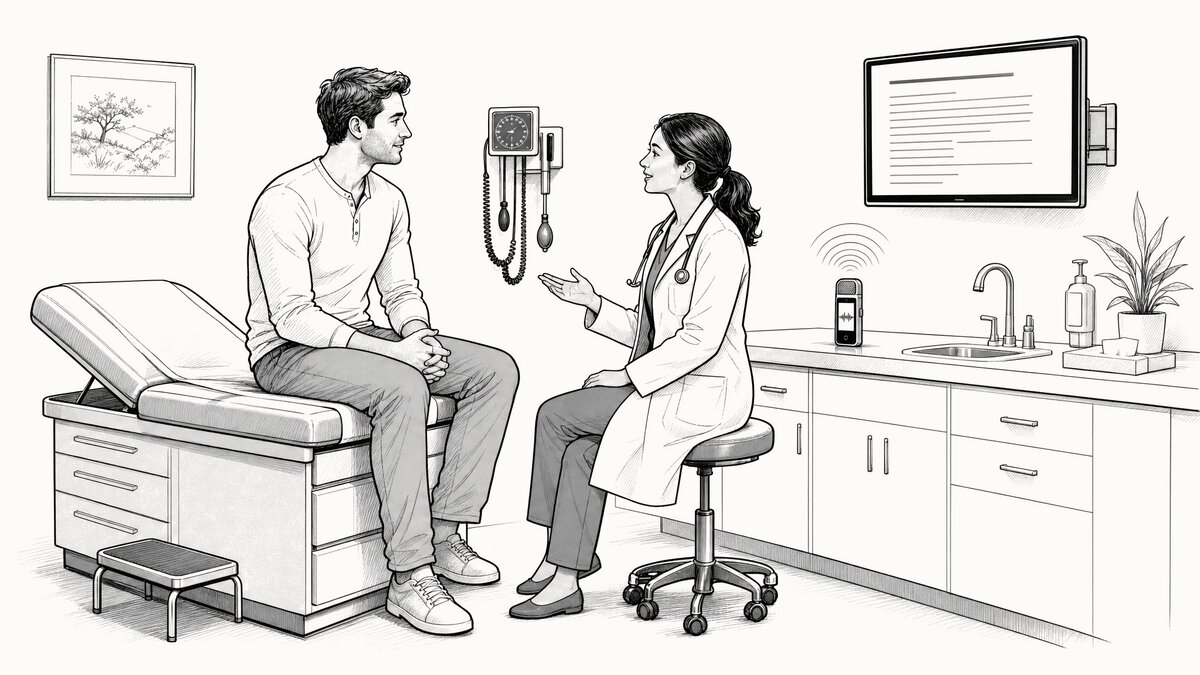
Rhode Island signed three artificial-intelligence laws on June 22, and the one drawing the most attention governs a tool that has spread fast through clinics and hospitals: the ambient AI scribe that listens to a visit and drafts the note. Coverage has labeled it an “opt-out” law. Read the statute, though, and opting out is the one thing it doesn’t require.
What the law actually says
The scribe provision — House bill 7538, paired with Senate bill 2570 — is short. It applies to any healthcare provider or facility that uses AI to document a visit, and it took effect the moment Governor Dan McKee signed it. The operative language:
Any and all healthcare providers and healthcare facilities that employ artificial intelligence (“AI”) to document in-person or telehealth visits shall notify patients of the use of AI for that sole purpose and review the AI-generated documentation for accuracy after the visit.
Two obligations, then: tell the patient AI is being used, and check the draft for accuracy once the visit is over. Both in-person and telehealth encounters are named. “Healthcare provider” is defined broadly — physicians, PAs, nurses, and anyone else licensed by the state health department — so the rule reaches well past physician practices.
The opt-out that isn’t there
Here is where the label and the law part ways. The bill’s sponsors and most of the coverage describe it as handing patients a choice. State Senator Pamela Lauria, a nurse practitioner who sponsored the measure in the upper chamber, said in a legislative release that patients “will always be notified when AI-transcription is used in their visit and have the option to opt-out if they are not comfortable.”
That option doesn’t appear in the enacted text. The statute mandates notification and an accuracy review — nothing about consent, declining, or a patient’s right to refuse. It names no penalty, no enforcement agency, and no path for a patient who objects. An earlier draft was notification-only; the accuracy-review clause was added before passage, but the opt-out never made the trip from the press release into the law.
The gap matters for anyone who has to comply. A notify-and-review rule is a documentation-and-workflow task. An opt-out right is a consent system with a fallback for the patient who says no. Rhode Island passed the first while talking about the second.
What a practice has to do now
For an organization already running an ambient scribe — Abridge, Microsoft’s Dragon Copilot, Ambience Healthcare, or any of the rest — the compliance lift is modest but real, and it is live today. Two steps belong in the workflow: a patient-facing notice that AI will document the visit, given at intake, and a clinician step to review and attest to the note before it is signed. The accuracy clause is the easier one to overlook and the more consequential, because it puts the provider, not the model, on the hook for what lands in the record.
The missing penalty doesn’t make the law optional, and it doesn’t settle the consent question. Rhode Island is otherwise a one-party-consent state, and the sponsors plainly intended for patients to be able to refuse — so building a decline path anyway, a fallback to a human-typed note, is the careful reading, and it costs little next to the notification you already owe.
The rest of the package
The two companion laws are narrower. One — House 7349 and Senate 2197 — takes on AI in mental-health care: it bars offering AI “therapy or psychotherapy services” to the public unless a licensed professional delivers them, and forbids a licensed clinician from letting AI make independent therapeutic decisions, set treatment plans, or run a session unsupervised. Written, specific consent is required before AI assists in a recorded session; FDA-cleared tools are exempt. The ACLU of Rhode Island backed the bill while warning that one section is “overly broad” and could run into the First Amendment.
The third — Senate 2195 and House 7350 — reaches consumer “AI companion” products rather than clinical software, and it is the only one with real teeth. From January 1, 2027, operators must build in suicide and self-harm crisis protocols and tell users they are not talking to a human at the start of a session and every three hours after, with the attorney general able to fine violators up to $15,000 a day. Most provider IT shops won’t qualify as “operators” — this targets the Character.AI and Replika tier — but it is worth a read if you build or resell a patient-facing chatbot.
Where Rhode Island fits
Rhode Island lands among the first states to write a rule aimed at AI documenting the visit itself. California’s 2025 law, AB 3030, covers AI-generated patient communications — the result email, the after-visit summary — not the scribe in the room.
None of that makes Rhode Island’s approach a model — a notice with no teeth and an “opt-out” that isn’t in the text is a soft first step. But the direction is plain: as ambient AI moves from pilot to default in the exam room, what you tell the patient is becoming law, one state at a time. If you run these tools, the move now is to make the notice and the accuracy check real, written down, and actually happening — whatever the enforcement looks like on paper.
Sources
- Rhode Island H 7538 Substitute A — Healthcare Provider AI Notification (enacted text)
- Rhode Island S 2570 Substitute A — Senate companion (scribe)
- Rhode Island General Assembly - press release on the AI notification bill
- Rhode Island H 7349 Substitute A — AI in Mental Health Care (enacted text)
- Rhode Island S 2195 Substitute A — AI Companion Models (enacted text)
- LegiScan - H 7538 action history and signing
- Healthcare IT News - Rhode Island passes ambient AI scribe opt-out law
- ACLU of Rhode Island - AI use in mental health care (H 7349 / S 2197)
- Future of Privacy Forum - California AB 3030 and generative AI in patient communications