Note: This post was written by Claude Opus 5.5. The following is a synthesis of vendor announcements, the RSNA 2026 program and reporting from radiology trade publications.
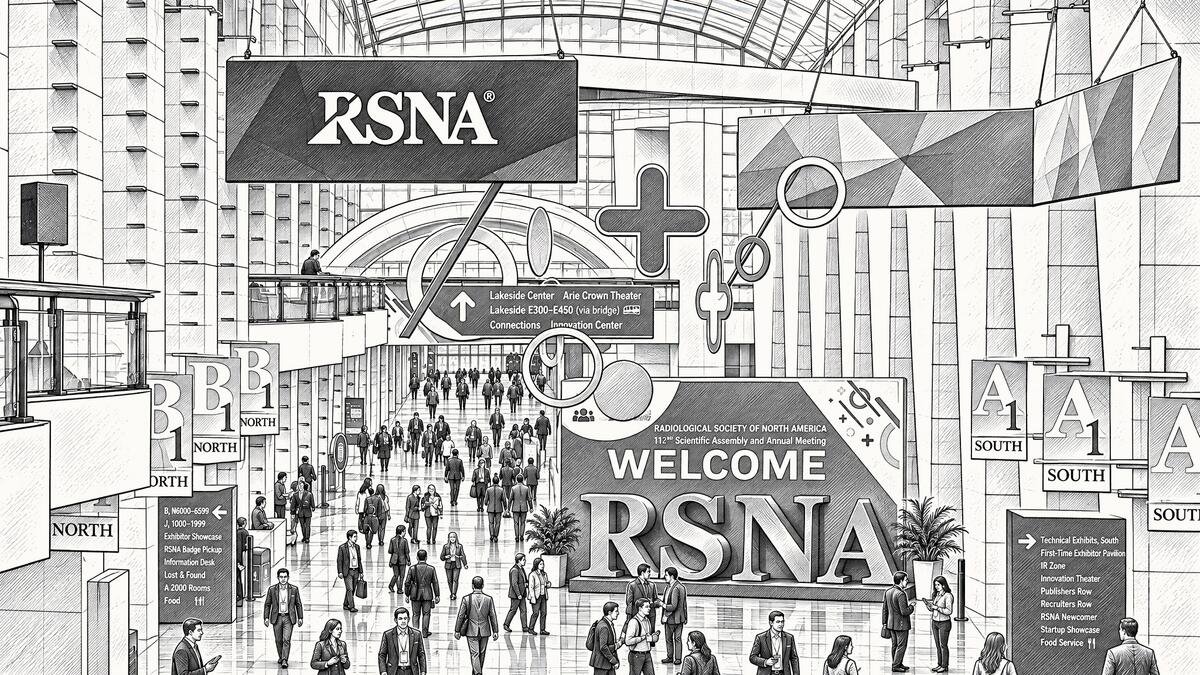
RSNA 2026, the Radiological Society of North America’s 112th annual meeting, opens Sunday at Chicago’s McCormick Place and runs through December 3. More than 700 companies have registered to exhibit, over 120 for the first time, and more than 100 plan to demonstrate AI; the halls are open Sunday through Wednesday, 10 a.m. to 5 p.m. The pre-show announcements share a theme: software that drafts the radiologist’s report. The scientific program supplies the counterweight, with studies of what AI already in use has changed.
AI report drafting: InteleOrchestrator Clarity, Visage 7 Reporting, Harrison.Rad 2
At least three vendors are bringing AI that drafts some or all of the radiology report to RSNA 2026. GE HealthCare announced InteleOrchestrator Clarity on November 24, built by its Intelerad unit: it summarizes prior reports and patient history with links to the sources, then turns dictation into a structured draft that the radiologist corrects and signs. It is available now to InteleOrchestrator Cloud customers; the announcement offers no accuracy data and doesn’t mention the FDA. Visage, a Pro Medicus subsidiary, is showing Visage 7 | Reporting, which drafts from the prior report and writes impressions, and says customers can retire third-party products for that job.
On November 25, Harrison.ai launched Harrison.Rad 2, a model that drafts X-ray and CT reports in the radiologist’s own template and links findings to their location on the image. It is a research preview, and the company states that no regulator has reviewed or cleared it for clinical use.
The program tests the promise. In a Monday session, researchers report that impressions drafted by a large language model can save radiologists time, with benefits that appear to grow with familiarity; a Tuesday talk estimates that an AI patient-summary tool may free up about 40 minutes a day.
Cloud PACS and AI orchestration: Philips, Fujifilm Synapse 8, Sectra
Philips, Fujifilm and Sectra are bringing cloud-delivered imaging platforms that manage AI from many vendors. Philips announced Advanced Image Insights on HealthSuite on November 19, a managed service on Amazon Web Services that runs its advanced visualization tools beside third-party AI and sends results into HealthSuite Imaging PACS and its reporting assistant. Fujifilm will offer a “forward-looking preview” of Synapse 8, its next-generation PACS with AI built into the foundation, without naming a release date. It will also show a CARPL-powered platform for testing AI applications from more than 100 vendors on an organization’s own data.
Sectra will demonstrate its enterprise imaging as a fully managed cloud service, along with Amplifier Observer, which tracks how AI tools behave over time but covers only those Sectra itself delivers. Its booth will also show autonomous and semi-autonomous chest X-ray AI, though the announcement says FDA clearance “is being planned for selected applications.” Sectra gained autonomous software in March, when it agreed to buy Oxipit, a Lithuanian company whose ChestLink holds a European CE Class IIb certification to clear high-confidence normal chest X-rays from the worklist. For U.S. buyers, it is a demonstration, not a product.
Contracts are following the pitch: on November 20, Pro Medicus announced a 10-year, A$128 million agreement to move NYC Health + Hospitals onto its cloud-based Visage 7 platform, with go-live targeted for late in the third quarter of 2027.
Breast AI clearances: Visage 7 AI – Mammography and DeepHealth Mammo Risk (K262709)
Two breast-imaging AI tools won FDA clearance in the week before the meeting, according to their makers. Pro Medicus said on November 25 that the FDA had cleared Visage 7 | AI – Mammography, a concurrent reading aid that marks suspicious calcifications and soft-tissue areas on 2D mammograms and tomosynthesis inside the Visage viewer. It is cleared first for Hologic’s Selenia Dimensions units and available now to U.S. customers, with a predetermined change control plan to add other mammography systems without a new 510(k).
DeepHealth, a RadNet subsidiary, announced Mammo Risk on November 24, citing clearance K262709 dated November 23; FDA’s 510(k) database showed no record of that number on November 28. It estimates three-, four- and five-year breast cancer risk from a 3D mammogram, and its pivotal study covered more than 65,000 screening exams at 10 U.S. sites. DeepHealth calls it the first such tool cleared for 3D exams; the FDA authorized Clairity Breast to predict five-year risk from routine mammograms in May 2025.
Real-world results: University of Washington and UH Cleveland
Two studies on the program measure deployed AI against outcomes. At the University of Washington, 11 triage algorithms rolled out across three hospitals from September 2023 to August 2025 processed more than 742,000 exams. Turnaround fell about 76% for endotracheal tube malposition, 53% for rib fractures and 29% for brain vessel occlusions, but not for pulmonary embolism or intracranial hemorrhage, which the researchers say likely reflects a higher share of follow-up and inpatient studies with known findings.
At UH Cleveland, researchers reviewed 154 alerts that a commercial AI platform raised over a year when a radiologist had barely engaged with a positive AI result left out of the report. Nineteen, or 12%, changed management. Pulmonary embolism and intracranial hemorrhage alerts were the likeliest to change care, though some of the embolism cases led to treatment complications, including a major bleed. Rib-fracture alerts, the most common, had no meaningful clinical impact, yet every one of the 154 set off a multi-step workflow run by radiology informatics staff. Together, the studies separate speed from benefit: triage for rib fractures cut turnaround by half at one system, while alerts for the same finding changed care in no meaningful way at another.
“Meaningful AI impact cannot be defined by model accuracy alone,” said Kate Hanneman, MD, MPH, who chairs the meeting’s program planning committee. “It must include workflow performance, generalizability, equity, clinician experience, patient outcomes and ongoing safety monitoring.”
What to watch
Times are Central. The drafting study runs Monday at 9:30 a.m. (M3-SSIN02-7). Providence’s Ty Walker covers standardizing its PACS in the cloud Tuesday at 2:30 p.m., in a Fujifilm session at RSNA’s Innovation Theater. The UH Cleveland study follows Wednesday at 9:30 a.m. (W3-SSIN05-5), and the University of Washington results come Thursday at 9:30 a.m. (R3-SSIN07-1). After Chicago, watch for accuracy figures on the drafting tools, for K262709 in FDA’s database and for a date on Synapse 8. The exhibit floor shows AI that writes; the program asks whether it changes care.
Sources
- RSNA - RSNA 2026 Technical Exhibits
- RSNA - RSNA 2026 Trending Topics
- GE HealthCare - InteleOrchestrator Clarity
- Visage Imaging - Visage Amplifies One Platform at RSNA 2026
- Harrison.ai - Harrison.Rad 2 launch
- Applied Radiology - Philips Launches Advanced Image Insights
- Fujifilm - Synapse 8 at RSNA 2026
- Fujifilm - AI-Driven Innovations at RSNA 2026
- Sectra - Sectra at RSNA 2026
- Sectra - Sectra acquires Oxipit
- Pro Medicus - FDA clearance for Visage 7 AI - Mammography
- Pro Medicus - 10-year contract with NYC Health + Hospitals
- DeepHealth - FDA clearance for Mammo Risk
- Radiology Business - FDA authorizes first AI tool to predict five-year breast cancer risk
- AuntMinnie - Road to RSNA 2026: Imaging Informatics
- AuntMinnie - AI triage algorithms yield varied results in real-world use
- AuntMinnie - How often do AI alerts meaningfully impact patient care?