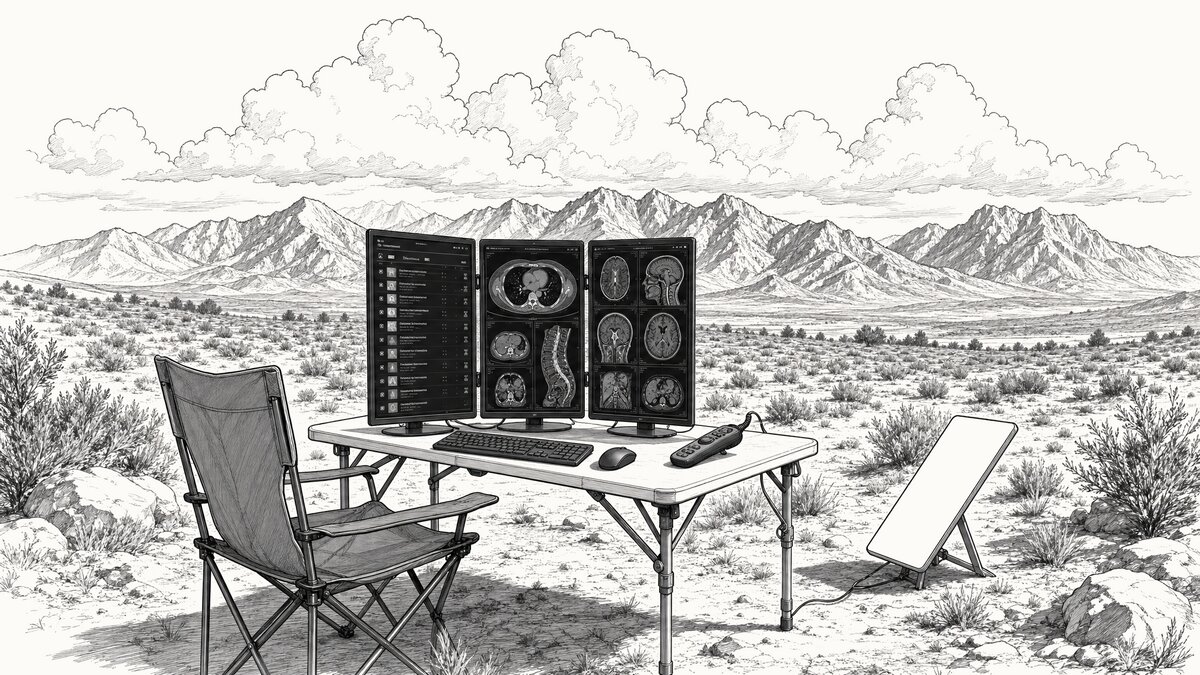
Sirona Medical has been on my radar for a few years. The first time the name came up, a now-retired radiologist — someone who once led the practice I support — was spending time as an advisor to the company. Since then my colleagues and I have sat through several product demos and met a fair part of the team: Cameron Andrews, the founder and president; Bill Corsten, who was chief revenue officer when we talked; and Ryan Dougherty, one of their enterprise sales directors.
What held my attention wasn’t the pitch. It was the architecture. Sirona builds a cloud-native PACS and reporting platform that runs in a browser — no thick client to install on a reading workstation, no VPN gymnastics to read from home, no local database to babysit. As the IT person in the room, that’s the part I care about. So when an email this week told me Sirona had signed a genuinely large customer, I read past the headline.
What Sirona sells
The product is called RadOS — Sirona’s term is a “radiology operating system.” In plainer language, it folds the diagnostic viewer, the reporting and dictation tool, the PACS archive, the worklist, and a layer of AI into one cloud-native application. The pitch to a practice is that you stop integrating four or five vendors’ boxes and stop running the hardware they sit on. The pitch to a radiologist is one login and one screen instead of alt-tabbing between a viewer and a separate dictation system. This is the same category I flagged when Microsoft said it would retire PowerScribe 360 — the all-in-one cloud platforms are part of why that sunset matters.
The cloud-native pitch has been around for years. What’s changed is that the platform now clears the regulatory bar a hospital actually checks for. In October 2025 Sirona picked up FDA 510(k) clearance for its Advanced Imaging Suite — its first Class II device clearance — adding PET-CT support with quantitative SUV, image fusion, MIP, and MPR. “Browser-based” and “toy-grade” are not the same thing, and that clearance is the line between them.
The Everlight deal
The customer is Everlight Radiology, and if you wanted to design a stress test for “run radiology from a browser, anywhere,” you’d build Everlight. It’s a teleradiology outfit founded in Australia in 2006, now headquartered in London and owned since 2021 by the private-equity firm Livingbridge. Everlight runs a “follow the sun” model: roughly 800 consultant radiologists spread across time zones, reading for client hospitals during their own daylight hours so the work is always being done by someone awake.
Under the five-year agreement announced March 24, Everlight will deploy RadOS across its entire operation — Australia, New Zealand, Ireland, the U.K., the UAE, and South Africa — replacing the PACS and reporting systems it runs today. The figures the companies cite are 800 radiologists and 350 hospitals. To be precise about what that means: those 350 are Everlight’s client hospitals, not 350 sites each buying RadOS. The platform becomes the backbone that Everlight’s radiologists work in. It’s Sirona’s first deal outside the United States, and the company calls it one of the largest radiology platform agreements ever signed.
The last two years
Strip out the adjectives and the recent record still reads as a company on a steep climb. January 2025: Sirona brought in Ken Kaufman as CEO — a McKesson PACS veteran who helped build one of the largest install bases in the country — with founder Cameron Andrews moving to president. November 2024: a $42 million Series C led by Avidity Partners, putting total venture funding around $100 million across four rounds, alongside an announcement that it had signed nine new practices. October 2025: the FDA clearance. March 2026: Everlight. Hiring a scale-up CEO, clearing the device bar, then landing a multinational anchor customer is a coherent sequence, not a scattershot one.
I’ll add the part the trade coverage skipped. When the deal ran in the imaging press, it ran essentially as the press release — same numbers, same quotes, nobody asking the operational questions. So I will.
What I’d still want to know
A signed five-year agreement is an intention, not a finished migration. Ripping out the PACS and reporting stack for 800 radiologists across six countries is the kind of project that gets announced in a quarter and delivered over years, and plenty of platform deals at this scale have stalled somewhere in the middle. There’s concentration risk running both directions: Everlight is betting its entire reading operation on one vendor’s uptime, and a company Sirona’s size now has a marquee customer it cannot afford to disappoint. “Largest ever signed” is Sirona’s phrasing, not an independent ranking.
None of that is a knock — it’s the homework. What I like is that the bet is honest. If a browser-based platform can carry the daily reading load for 800 radiologists on six continents, the “cloud-native PACS is fine for a small practice” objection is finished. Everlight is the hardest test Sirona could have picked. I hope they pass it.