At the risk of oversharing, I’d like to tell a story about myself.
I used to think of myself as a solo thinker. An individual. One who happened to be leading a team in a relatively complex mid-sized business, sure. But at heart, an individual.
On Friday, I learned something new about myself. I learned that the individualism might have changed. Or that I was wrong about myself all along.
A Year of Meetings
Since January, my team and I have been executing a major project on a tight — some might say unrealistic — timeline. We have until August 11 to finish. I asked five frontier LLMs how long a project like this should take. Their blended answer: fourteen to twenty-one months, with the finish line somewhere between March and September of next year.
So, we’ve had a lot of meetings this year. I’ve had approximately 540, most of which I led or joined as a principal participant. I’ve gotten into a groove with it. For every meeting, I digitally transcribe the conversation, use an LLM to organize it into meeting notes, and commit the result to a GitHub repository — a running history of nearly every meeting I’ve been in since January 1. Some days are nothing but meetings and their follow-up documentation.
Given the expectations, I haven’t had much time off. One day in January for an AI event in New York City — probably twelve hours counting the train at both ends. A few days in February for a family member’s funeral. To my knowledge, that’s every day off I’ve had in 2026. Finding continued motivation can be a personal challenge.
The Wall
This week brought detailed request lists from two senior leaders in our organization. One came in Friday. To be honest, I could barely look at it until after lunch. After another long week, I didn’t have what it took.
The Meeting
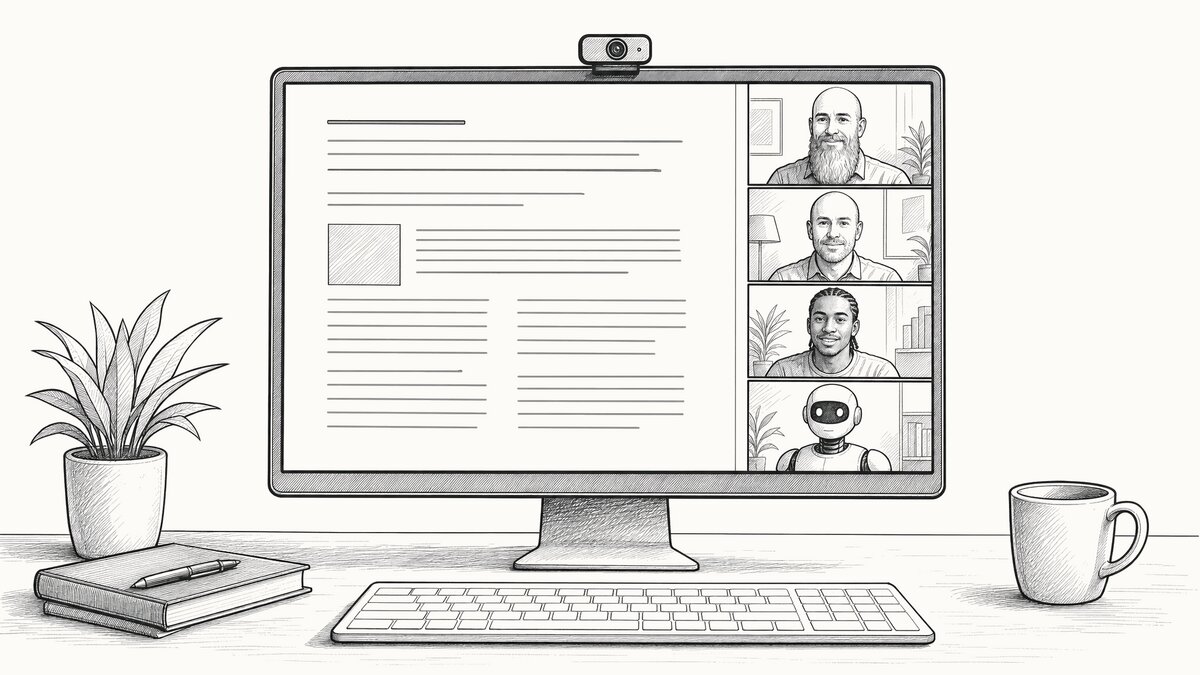
Finally I pulled two people from my IT team into a Teams meeting. I went through the email in presentation mode, sharing my screen line by line. I realized that, like usual, I was doing more of the talking than I should.
But somewhere in the middle of it, a switch flipped. By the end of the call I was fully engaged. I spent the rest of the afternoon working the list and sent out a summary response just after 5:00 PM.
Here’s the part I didn’t expect. I can now engage my thinking better in a Teams meeting than in any other format. Particularly when I’m feeling mental resistance.
What the Research Says
Psychologists have names for pieces of this. A 1989 study by Michelene Chi and colleagues found that students who talked themselves through worked examples learned far more than those who studied silently. A 2014 study found something stranger: people who studied expecting to teach the material later recalled it better and organized it more effectively — even though they never taught anyone. Just anticipating an audience changes how the brain works.
Then there’s the philosophical frame. In 1998, Andy Clark and David Chalmers published The Extended Mind, arguing that cognition doesn’t stop at the skull — a notebook, reliably used, becomes part of the mind itself. They explicitly extend the idea to other people: a trusted collaborator can play the same role as the notebook. Certain social activity, they wrote, might be “less akin to communication and action, and as more akin to thought.”
Yes, an LLM found those examples in seconds.
What I Think Happened
Maybe I’ve done so many meetings this year that I rewired my brain. For thirty years, my hard thinking happened at a quiet desk, and my brain wired itself for that context. This year the hard thinking happened in Teams windows, and the wiring followed.
For years I believed my best thinking happened alone — quiet desk, empty calendar. I’m no longer sure that’s true. Maybe it was true once and isn’t anymore.
The Takeaway
I’ll lean on this discovery going forward, particularly when the going gets tough. When the resistance hits — the email I can’t bring myself to read until after lunch — the answer isn’t more solitude and more willpower. It’s booking the meeting.
The solo thinker had a good run. It took 540 meetings to find out he works differently now.