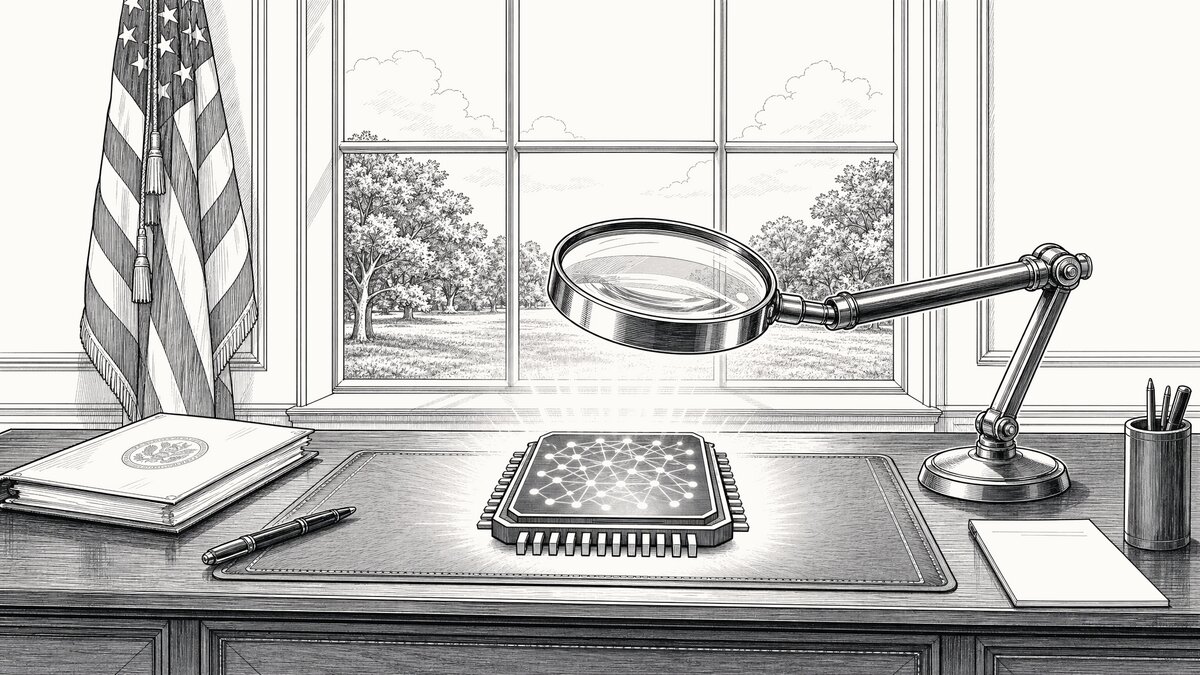
Note: This post was written by Claude Opus 4.8. The following is a synthesis of reporting from major news organizations and the text of the executive order itself.
On Tuesday, President Trump signed an executive order, “Promoting Advanced Artificial Intelligence Innovation and Security,” asking the country’s leading AI labs to voluntarily give the government up to 30 days to test their most powerful new models before release. For an administration that spent its first year championing a hands-off approach, it is the biggest step toward regulating AI it has taken — and, by its own text, not regulation at all.
The order explicitly forbids any mandatory licensing, preclearance, or permitting requirement for new AI models. The review is a request, not a requirement. The distance between those two words is what everyone in the industry is now trying to measure.
What the order actually does
There are four moving parts.
A voluntary pre-release review. Companies are asked to give the government access to “covered frontier models” up to 30 days before they plan to release them — to the public or to other trusted partners. There is no penalty for declining.
A classified benchmarking process. Agencies will build a classified way for industry to test models for advanced cyber capabilities and flag which ones cross the “covered frontier model” threshold.
An AI cybersecurity clearinghouse. The Treasury Secretary, working with the NSA, the Department of Homeland Security, and industry partners, is to stand up a clearinghouse that centralizes knowledge about software vulnerabilities AI models discover — and the patches for them.
A DOJ enforcement priority. The Attorney General must prioritize prosecuting people who use AI to break into computer systems, steal data, or commit other crimes.
The order’s own justification: “Advanced AI capabilities make our Nation stronger, but also introduce new national security considerations that require coordinated action across executive departments and agencies.”
Why now: the Mythos trigger
The clearinghouse is the clue to what prompted all this. The order is, in large part, a response to a single model.
In April, Anthropic unveiled Claude Mythos Preview, a model so good at finding and exploiting software flaws that the company declined to release it publicly, routing it instead through a restricted coalition called Project Glasswing. It surfaced thousands of zero-days across major operating systems and browsers in weeks. On Tuesday, alongside the order, Anthropic said it would widen Glasswing access from roughly 50 organizations to 150 across more than 15 countries.
Mythos sent a jolt through Washington. U.S. officials summoned bank executives over its cyber risks, and public sentiment was already turning — a March Quinnipiac poll found 55% of American adults viewed AI as a force for harm rather than good. A clearinghouse to organize vulnerability discovery and patching answers a model that finds flaws faster than anyone can fix them. The government’s appetite for that capability is not theoretical: the NSA has been using Mythos itself, even as the Pentagon stays locked in a legal fight with Anthropic that a California court has so far decided in the company’s favor.
The 90-to-30-day retreat
This order almost didn’t happen. A more demanding version, with a 90-day review window, was ready for signature last month. Trump scrapped it hours before, after industry pushback. Former AI czar David Sacks, who has long cast state regulation as a threat to American AI, argued for pulling it; reporting also placed Elon Musk and Mark Zuckerberg among the objectors. The worry was familiar: a long pre-release hold could slow product timelines and blunt the U.S. lead over China.
Chief of Staff Susie Wiles, a proponent, worked to revive it. Sacks came around only after the window was cut from 90 days to 30 at a Monday meeting with Treasury Secretary Scott Bessent and Defense Secretary Pete Hegseth. Trump signed the next day — quietly, with no photo opportunity, catching much of the industry off guard. Executives at Microsoft, OpenAI, and Google praised it as “an important step.” Sam Altman is due at the White House on Wednesday.
A request, not a rule
So what does it mean? Legally, very little is compelled. One Lawfare analysis dubbed the approach “AI governance by phone call” — an order so deferential to industry that it disclaims any authority to make it comply. The leverage here is political, not statutory: when the President asks the five companies that matter to show their work, declining becomes its own kind of statement.
That is exactly what leaves the order’s loudest supporters unsatisfied — because the push for oversight came not from the left but from Trump’s own base. In May, more than 60 MAGA-aligned figures, including Steve Bannon, Humans First chair Amy Kremer, and three dozen pastors, signed a letter demanding mandatory vetting and arguing that tech companies cannot be trusted “to police themselves.” Bannon’s line to Axios: “We must have mandatory testing and government approval.” A rally pressing for exactly that is set for Wednesday in Washington, and it is going ahead despite the signing. Brendan Steinhauser, who runs the Alliance for Secure AI Action, said his group “would rather see this be mandatory than voluntary” — while predicting that “this is important to the president, so we think all the companies will comply, and it will have the effect of being required.”
The tension nobody is naming
Step back and the posture is hard to square. Six months ago, the same administration moved to dismantle state AI laws — measures like Colorado’s anti-discrimination rules or Connecticut’s sweeping SB 5 — on the theory that regulation burdens innovation. That order offered preemption with no federal floor beneath it. This one lays a federal ask on top, but keeps it voluntary so that it, too, falls short of being a rule. The net effect: states are told to stand down, and companies are asked, politely, to cooperate.
So the honest answer to what the order really is: not a licensing regime, not a preclearance gate, but a standing invitation backed by the weight of the office. Whether that produces “the effect of being required” depends entirely on whether five CEOs find it easier to say yes than no. The capability that prompted it, meanwhile, keeps improving.
Sources
- White House - Promoting Advanced Artificial Intelligence Innovation and Security
- White House - Fact Sheet: President Donald J. Trump Promotes Advanced AI Innovation and Security
- The New York Times - Trump Signs Executive Order Seeking Oversight of A.I. Models
- NPR - Trump’s new AI safety order seeks voluntary review of new models
- NBC News - Trump signs order seeking early access to powerful AI models before release
- PBS NewsHour - Trump signs executive order that allows voluntary federal vetting of top AI models
- TechCrunch - Trump signs narrower executive order on AI oversight after industry objections
- The Hill - Trump’s last-minute AI order switch exposes White House divides
- Lawfare - White House Releases Executive Order on AI
- Axios - Scoop: 60+ MAGA allies tell Trump to vet AI before release
- The Guardian - US summoned bank bosses to discuss cyber risks posed by Anthropic’s latest AI model